


If you run a hotel in Greece, digital marketing for hotels is no longer optional — it is the difference between guests finding you directly and losing 25% of every booking to an OTA.
For a 30-room boutique hotel in Crete running at 75% occupancy through a seven-month season, the commission bill can easily exceed 60,000 euros annually. That is not a small line item. It is money that could fund a website rebuild, a Google Ads campaign, a full season of content, and still leave a surplus.
Digital marketing for hotels in Greece is not about replacing the OTAs. It is about reducing your dependency on them, building a direct relationship with your guests, and making your property visible in the places where modern travelers actually look.
This guide covers the full picture: from your website and SEO to Google Hotel Ads, AI search visibility, and social media. It is written for hotel owners, villa managers, and general managers who want to understand the landscape and make better decisions, not for marketing specialists.
Why digital marketing for Greek hotels is different from the rest of Europe
Greece is one of the most OTA-dependent hospitality markets in Europe. A combination of factors pushed it there: the dominance of package travel and third-party booking in the post-2010 recovery period, the relatively late adoption of direct booking technology among independent properties, and the sheer fragmentation of the market (most Greek hotels are small, family-operated, and without dedicated marketing staff).
The result is that many Greek hoteliers have effectively outsourced their distribution to platforms they do not control, at a cost that compounds year over year.
There are other factors that make the Greek market distinct.
Seasonality is extreme. On most Greek islands, the viable commercial season runs from May to October, sometimes shorter. That concentrates the entire year’s revenue into six months and puts pressure on every booking decision.
The guest mix is international but not homogeneous. Northern European guests, particularly from Germany, the UK, and Scandinavia, research and book months in advance and often use Google Search in English. Greek domestic tourists have different booking behaviors and use different platforms. A digital marketing strategy that ignores this split is leaving revenue on the table.
The language gap is real. There is very little quality content about Greek hotels and destinations written in Greek for Greek search audiences. For properties targeting domestic travelers, this represents an easy competitive advantage that most hotels have not taken.
Finally, the shift to AI-driven travel planning is happening faster than most hotel owners realize. Guests are now asking ChatGPT or Google AI Overviews questions like “which is the best boutique hotel in Oia with a caldera view” before they open any booking platform. If your property is not mentioned in those answers, you are invisible at the top of the funnel.
Your hotel website is either a booking machine or a brochure
The most common digital marketing problem Greek hotels have is not their ad spend or their social media. It is their website.
A hotel website that does not convert is not a marketing asset. It is a cost center. Most visitors who land on a hotel website and leave without booking will not come back directly. They will go to Booking.com, find the same property, and book through the OTA. The hotel pays a commission for a guest who was already interested.
The gap between a beautiful hotel website and a high-converting hotel website comes down to a few specific elements.
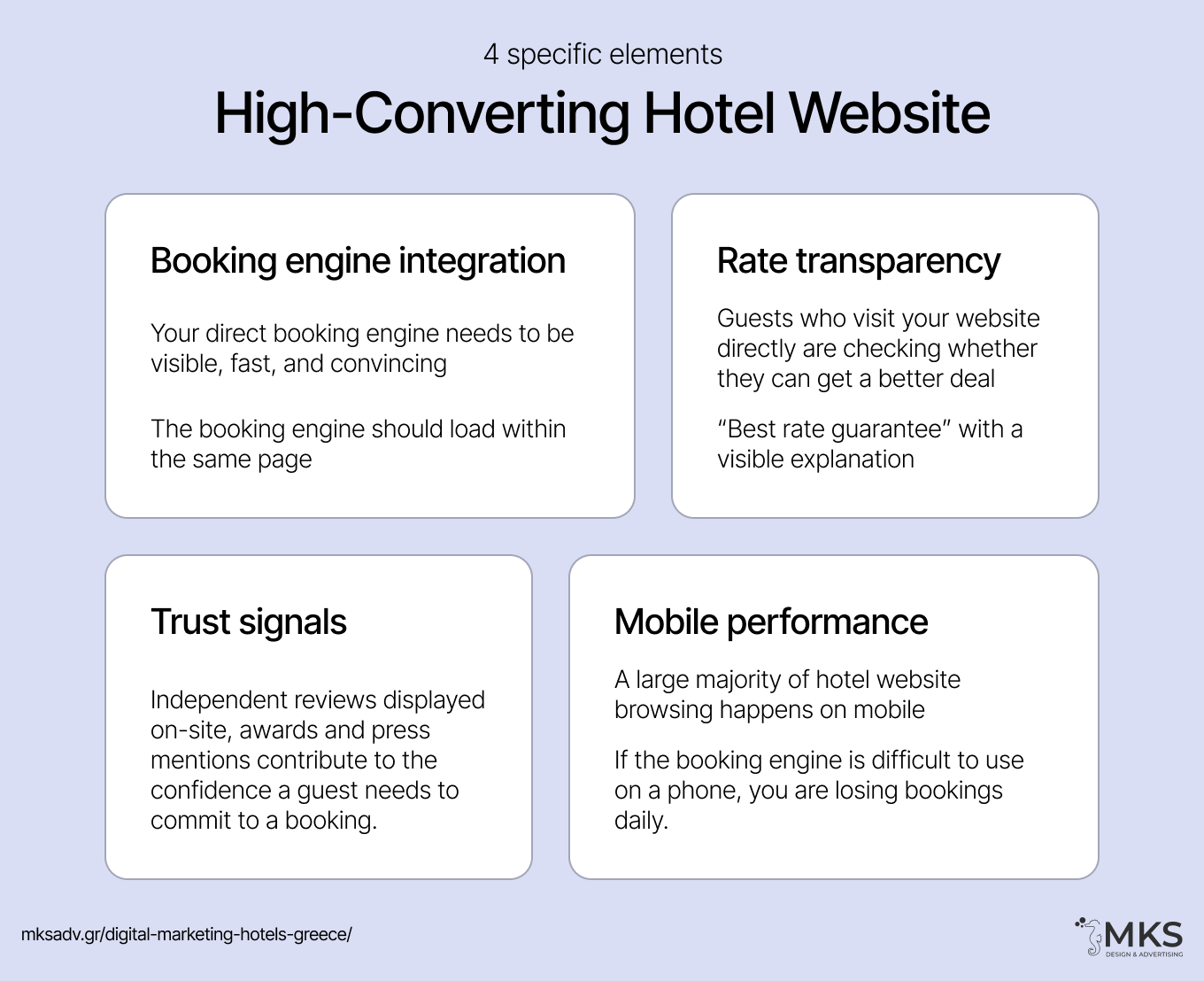
Booking engine integration. Your direct booking engine needs to be visible, fast, and convincing. If the process of booking directly is slower or more confusing than booking through an OTA, guests will take the easier path. The booking engine should load within the same page, not redirect to a third-party site, and should clearly display pricing and availability without unnecessary friction.
Rate transparency. Guests who visit your website directly are often checking whether they can get a better deal than on Booking.com. If your rates are identical and you offer nothing extra for booking direct, you are giving them no reason to change their behavior. A “best rate guarantee” with a visible explanation, combined with a small direct booking benefit (free early check-in, a welcome drink, a room upgrade when available), is enough for many guests to prefer the direct channel.
Trust signals. Independent reviews displayed on-site, awards, press mentions, and a visible address and phone number all contribute to the confidence a guest needs to commit to a booking. These are particularly important for boutique properties and villas where the brand is less established than a chain hotel.
Mobile performance. A large majority of hotel website browsing happens on mobile. If your site loads slowly or the booking engine is difficult to use on a phone, you are losing bookings daily.
SEO for Greek hotels: getting found without paying a commission
Search engine optimization for hotels is not complicated, but it requires consistency over time. The goal is to appear when potential guests search for your type of property in your location, without paying a cost-per-click or a commission to get there.
Google Business Profile is the single most underused tool in Greek hotel marketing. It is free, it puts your property directly on Google Maps and in local search results, and it displays your photos, reviews, contact details, and direct booking link to anyone who searches for you. Yet a significant number of Greek hotels have either an unclaimed profile or one that is poorly filled out.
A complete Google Business Profile includes accurate contact information, your full address, opening hours, high-quality photos updated at least seasonally, a direct link to your booking engine, and active management of reviews. Responding to reviews, both positive and critical, is a direct signal to Google and to future guests that the property is professionally managed.
On-page SEO for hotels follows the same principles as any local business. Your homepage and key landing pages should include the name of your location, the type of property, and the kind of guest experience you offer. Pages targeting specific searches (like “villa with private pool Santorini” or “boutique hotel Athens center”) should be written as genuinely useful pages, not thin pages stuffed with keywords.
Structured data markup deserves specific attention. Schema.org markup for Hotel and LodgingBusiness tells search engines exactly what your property is, where it is, what amenities it has, and how to book it. When implemented correctly, it can also improve how your property appears in AI search answers and Google AI Overviews. This is becoming increasingly important as more travel planning moves to AI-assisted search.
Content strategy rounds out the SEO picture. Destination guides, seasonal pages, and local experience content (hiking near your villa, the best beaches within 20 minutes, how to get from Athens airport to your property) attract guests earlier in the planning journey and build the topical authority that helps your property rank for competitive terms over time.
Google Hotel Ads: the direct booking channel most Greek hotels ignore
Google Hotel Ads are not the same as Google Search Ads or Display Ads. They are a metasearch product, which means they compare your direct rate against OTA rates in real time and display them side by side to the user. When a guest searches for your property on Google, a box appears showing the price on Booking.com, Expedia, and your direct website simultaneously.
Most Greek hotels are already appearing in this comparison, but only via OTA rates. If you have not set up a direct feed through your booking engine, you are showing up as more expensive or not appearing at all as a direct option. The OTA wins by default.
Setting up Google Hotel Ads requires two things: a booking engine that integrates with Google’s hotel platform (most modern systems do this), and a feed of your live rates and availability. Once connected, you pay either on a cost-per-click basis or a commission-per-booking model, typically around 10-12% for commission-based campaigns, compared to 15-25% through traditional OTAs.
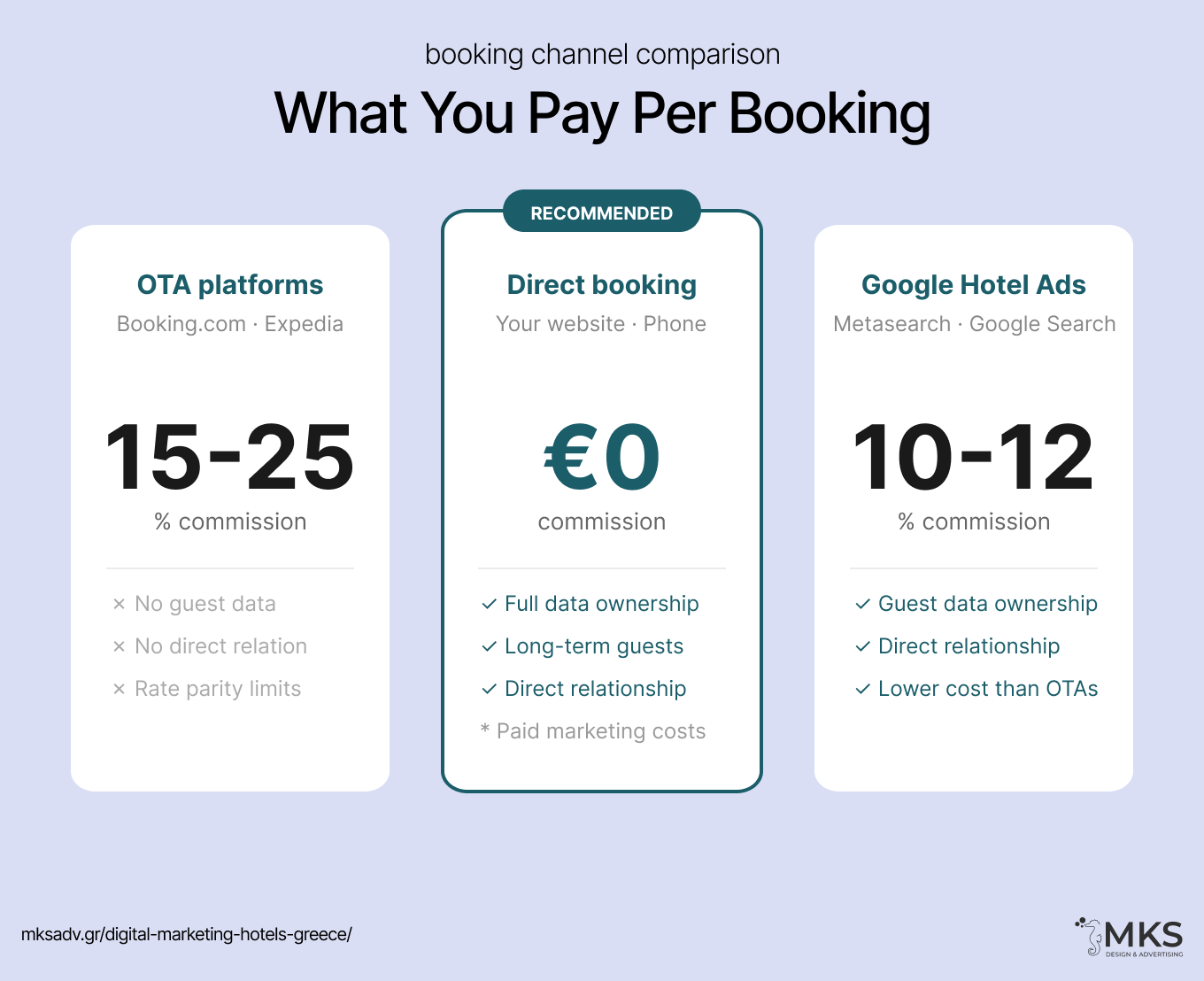
The broader advantage is data. Bookings that come through your direct channel give you the guest’s email address and booking preferences, which OTA bookings do not. Every direct booking is a relationship you own. Every OTA booking is a relationship the OTA owns.
For Greek boutique hotels and villas with average booking values above 500 euros, Google Hotel Ads often return the strongest cost-per-acquisition of any paid channel, including Google Search Ads. The reason is simple: the guest has already searched for your specific property. The intent is already there.
How AI search is changing the way guests find hotels in Greece
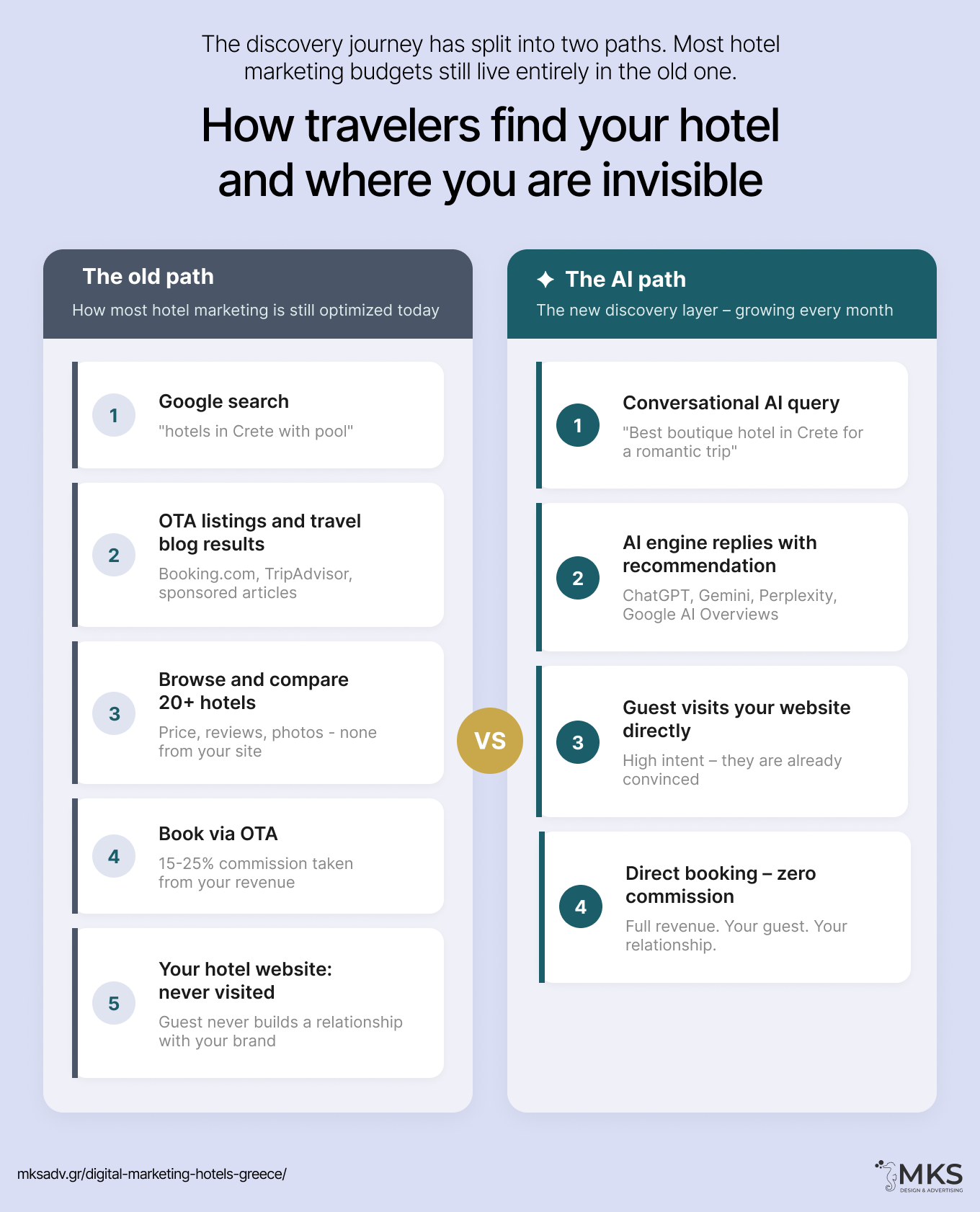
Until recently, the path a traveler took to find a hotel was predictable. They searched on Google, clicked through a few results, compared options on Booking.com, and booked. That path is changing.
An increasing number of travelers now begin their trip planning with a conversational AI query. They ask ChatGPT which islands are best for a quiet holiday with good food, or they ask Google AI Overviews for boutique hotels in Nafplio with parking. The AI answers with specific recommendations, often without the user ever clicking a traditional search result.
This matters because the criteria for appearing in AI-generated answers are different from the criteria for ranking in traditional search results. AI systems draw on multiple sources: Google’s index, review platforms, structured data on your website, mentions in travel publications, and brand consistency across directories and platforms.
A Greek hotel that has invested in structured data, that appears consistently across TripAdvisor, Google, booking platforms, and travel content, and that has been mentioned in credible travel content, has a higher chance of being cited in AI answers than a property that has only optimized for traditional keyword search.
The practical steps are not radically different from good SEO practice, but they require more attention to entity consistency (your property name, address, and category stated the same way everywhere), to content authority (being mentioned in the kinds of sources AI systems trust), and to structured data implementation.
Social media for hotels: what actually drives bookings vs what just looks nice
Social media is probably the most over-invested and under-strategized channel in Greek hotel marketing.
Instagram in particular attracts a significant amount of effort: professional photography, daily posts, Stories, Reels. The metrics reported are often follower counts and likes. The question that rarely gets answered is how many of those followers became guests.
The honest answer for most independent Greek hotels is that organic social media alone does not drive significant direct bookings. What it does well is reinforce the decision a guest has already made. A traveler who found your property on Booking.com and is deciding whether to book will often check your Instagram to see recent photos and get a sense of the atmosphere. Social media as a trust-building tool has real value. Social media as a primary acquisition channel is, for most properties, a poor return on time invested.
What does work on social media for Greek hotels is user-generated content: encouraging guests to tag the property, resharing genuine guest experiences, and building a feed that looks real rather than staged. Authenticity reads very differently to potential guests than polished content.
Paid social media, particularly Facebook and Instagram retargeting, has clearer measurable value. Visitors who came to your website but did not book can be shown targeted ads reminding them of your property. For high-average-value bookings typical of Greek boutique hotels and villas, the ROI on retargeting campaigns is generally positive and measurable.
Influencer collaborations work well when the influencer’s audience genuinely matches your guest profile and when the deliverable includes content you can repurpose beyond the original post. They work poorly when the goal is “more followers” without a clear connection to bookings or brand awareness among the right audience.
OTA commissions: what you are actually paying and what you can do about it
The standard commission on Booking.com for independent Greek hotels is between 15% and 18%, depending on your visibility program participation. Expedia runs similarly. For properties in the Preferred or Visibility Booster programs, the effective rate can be higher.
On a hotel generating 400,000 euros in annual revenue, a 17% average OTA commission rate means 68,000 euros going to platforms every year. That figure tends to grow as the hotel becomes more dependent on OTA traffic, because visibility on OTA platforms rewards high-commission participation.
The goal of a direct booking strategy is not to eliminate OTA bookings. OTAs provide reach, particularly to markets where your property has no independent visibility. The goal is to shift the ratio. A property doing 80% OTA and 20% direct has a very different cost structure than one doing 50-50.
Practical levers for improving that ratio include: a properly configured direct booking engine with clear rate and benefit advantages, Google Hotel Ads with live rate feeds, an email capture strategy for past guests, a loyalty or repeat guest incentive for direct bookings, and a clear “book direct” message visible on your website and social profiles.
Rate parity clauses in OTA contracts historically prevented hotels from offering lower rates on their direct channel. The regulatory landscape around rate parity has changed in several European markets, including Greece following EU directives. It is worth reviewing your current OTA contracts with this in mind, or consulting a legal advisor familiar with hospitality contracts.
What to measure: the 5 KPIs every Greek hotel owner should track
Digital marketing without measurement is guesswork. These are the five numbers that give you an honest picture of how your direct booking strategy is performing.
- Direct booking rate. The percentage of your total bookings that come through your own website or phone. If this number is below 30%, your direct channel needs attention. If it is below 15%, your business model is significantly exposed to OTA dependency.
- OTA commission ratio. Total OTA commissions paid as a percentage of total revenue. Track this monthly and year-over-year. A declining ratio, even by a few percentage points, represents meaningful money recovered.
- Website conversion rate. The percentage of website visitors who complete a booking. For hotel websites, a rate of 1-3% is typical. Below 1% suggests a booking engine or user experience problem. Tracking this requires Google Analytics 4 set up with booking engine events.
- Cost per direct booking. Total direct marketing spend divided by the number of direct bookings generated. Compare this against your average OTA commission per booking. As long as your cost per direct booking is lower than your average OTA commission, you are ahead.
- Revenue by channel. Tracking RevPAR (revenue per available room) broken down by booking source tells you which channels are delivering the highest-value guests. OTA guests and direct guests often have different average stay lengths, spend patterns, and rebooking behaviors. Knowing this shapes where you invest your marketing budget.