


For most boutique hotel and villa owners in Greece, the question of how to reduce OTA commissions for their Greek hotel is not new. What is new is that the answer has finally changed.
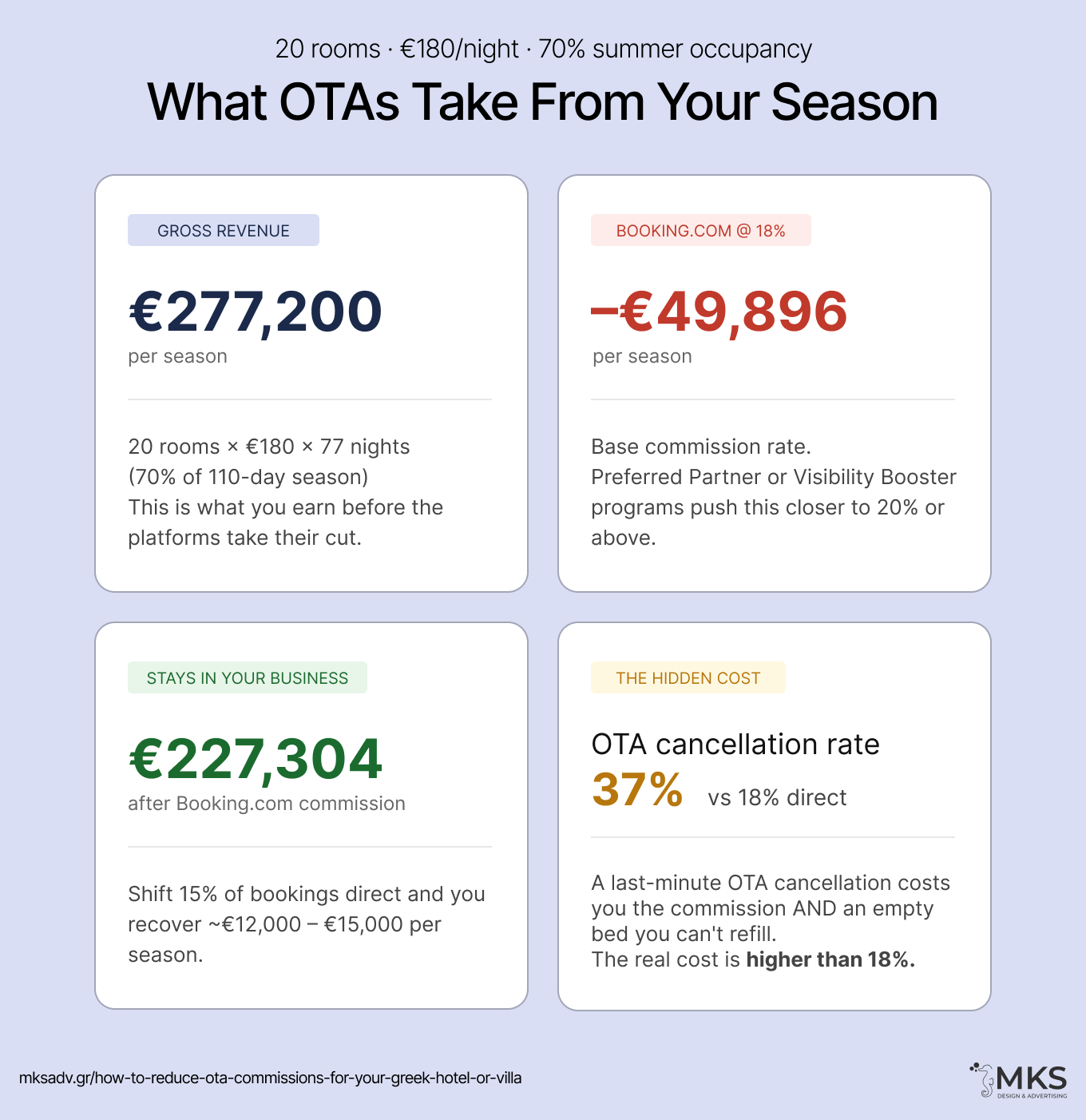
Take a 20-room boutique hotel in Crete. Seventy percent occupancy across the summer season. Average nightly rate of 180 euros. Run those numbers and you get roughly 45,000 euros handed to Booking.com every year. Not as a marketing expense you planned for. As a toll.
That number sits differently once you calculate it. And most hotel owners in Greece have never sat down to calculate it precisely.
OTAs solved a real problem. Before Booking.com and Expedia, a boutique property in Chania competed for international visibility against hotels with dedicated reservations teams and travel agent networks. OTAs levelled that field. The problem is that the relationship drifted from useful distribution channel to structural dependency, and the pricing terms got worse over time.
The good news, and it is genuine good news, is that the landscape shifted significantly in 2025 and early 2026. Greek hoteliers are pushing back legally, European law is on their side, and the behaviour of travellers is moving toward direct bookings in a way that was not true three years ago. The window to build a direct booking strategy that actually works is open right now. This article explains how to reduce OTA commissions for your Greek hotel or villa, and what that realistically looks like over 12 months.
The commission calculation most hotel owners do not do
The percentage is familiar. The annual number is not.
Booking.com charges a base commission of 15 to 18 percent per booking. Participation in their Preferred Partner or Visibility Booster programs pushes that figure higher, sometimes to 20 percent or above. Expedia sits in a similar range: 15 to 25 percent depending on the program tier and market. Agoda can run from 18 to 25 percent. These are not fixed numbers; they vary by property type, destination, and the level of visibility you have opted into.
For the Crete example above, at 18 percent commission, the annual cost is closer to 50,000 euros. That is before factoring in what industry data describes as the hidden cost most analyses skip.
OTA cancellation rates on major platforms run at approximately 37 percent. Direct booking cancellation rates sit at around 18 percent. A room that cancels via OTA at the last minute costs you more than just the commission. It costs you the full revenue of an empty bed you had already allocated.
The real cost of OTA dependency is therefore higher than the headline commission rate. You are paying for distribution you do not fully control, and absorbing a cancellation risk that the platform does not share.
Why Greek hoteliers are fighting back (and why this moment matters)
In November 2025, at the Xenia trade show in Athens, Hellenic Chamber of Hotels President Alexandros Vassilikos announced that over 1,000 Greek hoteliers had joined a pan-European lawsuit against Booking.com. The legal challenge targets rate parity clauses: the contractual terms that for years prevented hotels from offering lower prices on their own websites than the rate listed on the OTA.
The European Court of Justice has ruled these clauses anti-competitive and unnecessary for platforms to function. That ruling opened the door to the current legal action and, more practically, means that Greek hotels can now openly and legally offer a better rate on their own website than the one Booking.com shows.
That is not a small change. It removes the single most effective barrier to direct booking conversion: the perception that you cannot do better than the OTA price.
At the same time, traveller behaviour is moving. Nelios, which tracks direct booking data across Greek properties, reported a 33 percent rise in direct pre-bookings for 2026 compared to the same point the previous year. Crete led the surge with a 118 percent increase in direct bookings and a 165 percent jump in direct revenue. The guests are ready to book direct. The question is whether your property is ready to receive them.
The foundation you need before any strategy works
Here is the uncomfortable part. Most Greek hotel and villa websites are not set up to convert direct bookings even when a guest actively wants to make one. Before investing time or money in any of the strategies below, four things need to be in place.
A real booking engine, not a contact form
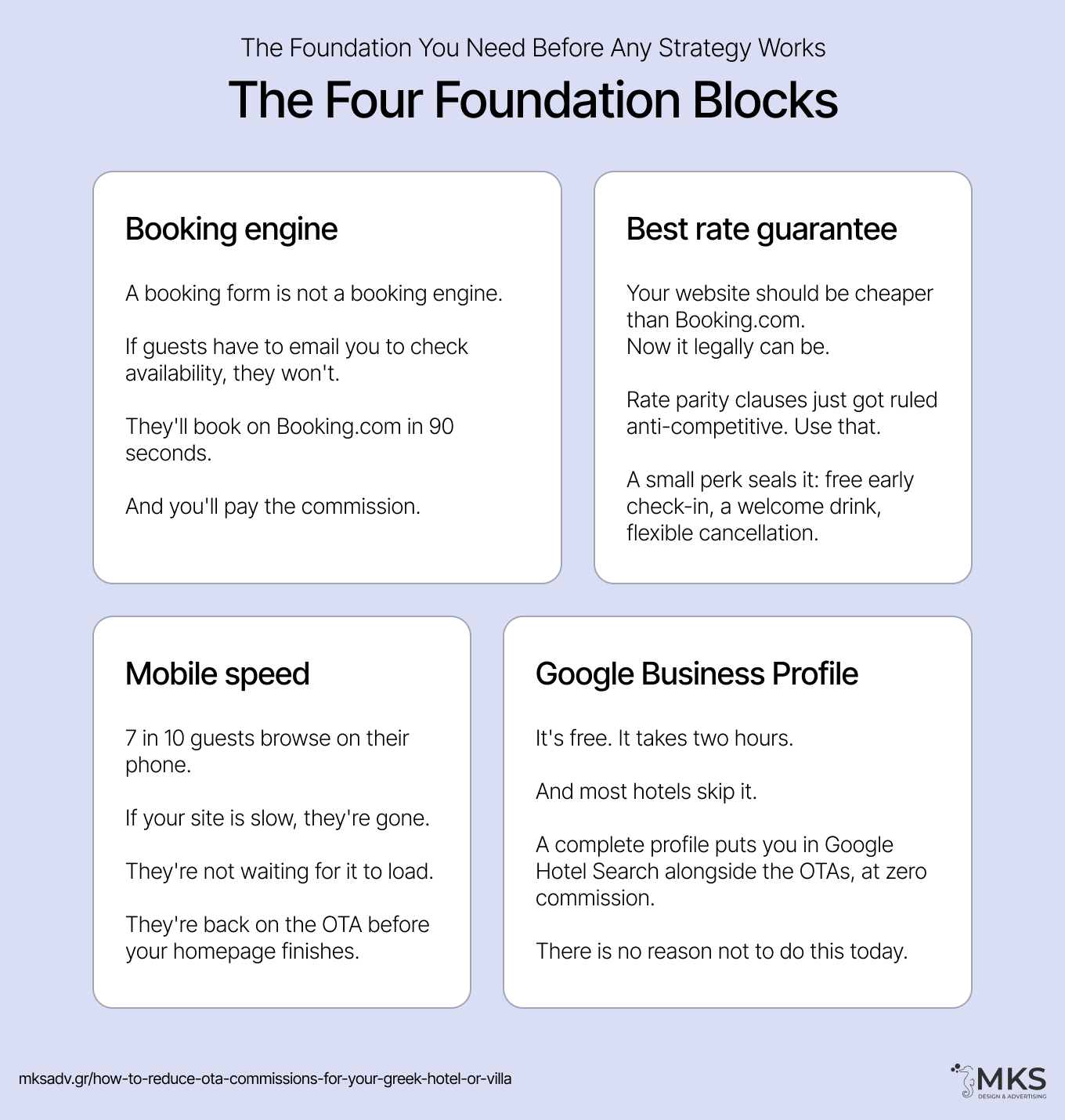
If your website asks a guest to send an email to check availability, they will not. They will go back to Booking.com, complete the reservation in 90 seconds, and you will pay the commission. A proper booking engine, integrated, mobile-first, with real-time availability and pricing, is not an upgrade. It is the baseline.
Visible best rate guarantee messaging
Now that rate parity clauses are being dismantled, you can offer a direct price advantage. Use it visibly. A clear statement that the best rate is available when booking directly, paired with a small tangible benefit like flexible cancellation, complimentary early check-in, or a welcome drink, shifts the decision for a guest who is already on your website. The benefit does not need to be expensive. It needs to exist and be easy to see.
A website that loads fast and works on mobile
Over 70 percent of travellers browsing Greek accommodation do so on a smartphone. A website that loads slowly or does not render properly on mobile loses those bookings before the guest even reaches the booking engine. Site speed and mobile optimisation are not technical luxuries. They are preconditions for everything else in this list.
A complete and current Google Business Profile
This is free and takes approximately two hours to do properly. A complete Google Business Profile directly determines whether your property appears in Google Hotel Search, which is the lowest-commission distribution channel available to you. Google Hotel Search connects directly to your booking engine, charges nothing for organic placement, and positions your property alongside OTA listings when a traveller searches for accommodation in your destination. Skipping this step while paying 18 percent to Booking.com is not a strategy.
Three strategies that actually move the needle
1. Build your own search visibility
OTAs spend hundreds of millions of euros on Google Ads every year. You will not outbid them on broad accommodation searches. What you can do is rank organically for the specific searches your ideal guest makes, and appear in Google Hotel Search for destination-specific queries.
Local SEO for your property means targeting phrases like ’boutique hotel Chania old town’ or ‘villa with private pool Paros’ rather than competing for ‘hotel Greece’. These searches have lower volume but significantly higher intent. Someone searching that phrase has made most of their decision already.
Google Hotel Ads, the metasearch product, shows your direct rate alongside OTA rates in search results and connects the booking directly to your engine. The typical cost per acquisition through Google Hotel Ads is 5 to 8 percent: meaningfully lower than the 15 to 20 percent you pay OTAs for the same booking.
Structured data on your website, the technical markup that tells search engines what your property is, where it is, what it costs, and what guests say about it, is now also a factor in how AI-generated travel recommendations surface hotel options. If you want to appear when someone asks ChatGPT or Google’s AI Overview for boutique hotels in Crete, structured data is part of how that happens.
2. Convert OTA guests into direct guests for next time
The most realistic path for most Greek boutique properties is not replacing OTA bookings overnight. It is converting the guests who arrive through OTAs into direct bookers for their return visit, or for the referrals they make to friends and family.
OTAs deliberately withhold guest email addresses from you. The moment a guest checks in, you have an opportunity the platform cannot take away: a direct relationship with a person who chose your property.
A post-stay email sequence, sent through your own booking engine or property management system, with a direct booking incentive for the following season, is one of the most cost-effective tools available. Frame it as a relationship benefit rather than a discount. Early access to availability, preferred room selection, and a rate that is genuinely better than what Booking.com will show: these are reasons to book direct that compound over time.
The key prerequisite is capturing the guest email address at check-in. This single habit, consistently applied, builds the asset that OTA relationships prevent you from having.
3. Create content that intercepts guests before they reach the OTA
If a guest discovers your property through a travel article, a destination guide, or an AI-generated recommendation before they open Booking.com, the OTA never enters the picture. This is not a theoretical advantage. It is how independent properties with strong content presences have quietly built direct booking shares of 40 to 50 percent.
Destination content on your own website serves two functions. For search engines, it signals that your site is a relevant authority for your location, which helps your property rank for destination queries. For guests, it demonstrates local knowledge and hospitality before they arrive, which builds trust and preference for your property over a comparable listing on a platform.
A practical starting point is three to five pages of useful destination content: the best local restaurants near the property, beaches worth visiting by car, seasonal events, honest advice about getting around. This content should live on your website, not just on your social media, because social media content does not help your search rankings.
What a realistic timeline looks like
This takes 12 months, not 12 days. Anyone who tells you otherwise is selling something.
A property starting from scratch should think about it in three phases.
The first two months are foundation work: booking engine in place, website speed and mobile experience improved, Google Business Profile completed and verified, rate parity messaging visible on the site. These are not glamorous tasks but they are the ones everything else depends on.
Months three to six are about search visibility: local SEO targeting your specific destination and property type, Google Hotel Ads set up and running, structured data implemented. These efforts take time to compound. Organic rankings do not appear overnight. Start early.
Months six to twelve are about conversion and retention: post-stay email sequences running, direct booking incentives in place, destination content published on the website. This is also when you start to see the compounding effect of earlier work, as organic search begins to deliver visitors who found you before the OTA did.
A realistic target for year one is moving from 85 percent OTA dependency to around 70 percent. On a 20-room property in Crete with average seasonal revenue of 250,000 euros, that shift represents approximately 12,000 to 15,000 euros per season that stays in the business rather than going to a platform. Not a transformation overnight. But a material, compounding change that gets easier to build on every year.
The Next Step
Reducing OTA dependency is a 12-month project, not a campaign. The properties that do it well start with the foundation: booking engine, website, Google Business Profile. Then they build search visibility. Then they convert guests into repeat direct bookers.
If you want to understand what that process looks like for your specific property, and what a realistic investment and timeline would be, we are happy to have that conversation.