


SEO for a Greek eCommerce store doesn’t get bolted on right before someone hits publish. It’s the way the store is organized. The way products get described. The way Google decides which page deserves the click over forty near-identical competitors.
The previous guide in this series covered why organic search compounds over time, unlike rented traffic. This one gets specific: what SEO actually means for a Greek online store in 2026, page by page.
Most Greek eCommerce stores don’t lose visibility because they’re missing some clever technical trick. They lose because nobody built the site with search logic in mind. Categories sit empty. Product descriptions get copied straight from the supplier catalog. The whole structure reflects how the warehouse organizes SKUs, not how a customer searches.
In 30 seconds
- Skroutz drives sales. It doesn’t build organic visibility that belongs to your own domain.
- Category pages are some of an eCommerce store’s most valuable SEO real estate, not just product grids.
- Product pages need original content, real detail, and a clean mobile buying experience.
- Product schema is baseline infrastructure for eCommerce SEO. It helps search engines read the page correctly.
- With five hours this week, start with the 3 core categories and the 10 highest-value products.
Why Many Greek eCommerce stores Stay Invisible on Google
A large part of eCommerce growth in Greece came through marketplaces and price comparison platforms. That changed the way many stores think about visibility. The focus moved to the product feed, price, availability, and marketplace position. The website itself often became little more than a checkout mechanism.
That does not mean Skroutz or marketplaces are the problem. For many stores, they are necessary sales channels. The problem starts when they become the only visibility plan. A marketplace listing is rented exposure. If you stop paying, if competition increases, or if the platform changes its rules, traffic can drop quickly.
Organic visibility on your own domain works differently. It is not bought from scratch every day. It is built with pages that have a reason to exist, content that does not look identical to every competitor, and a structure that helps both users and Google understand what you offer.
Fix the eShop Structure First
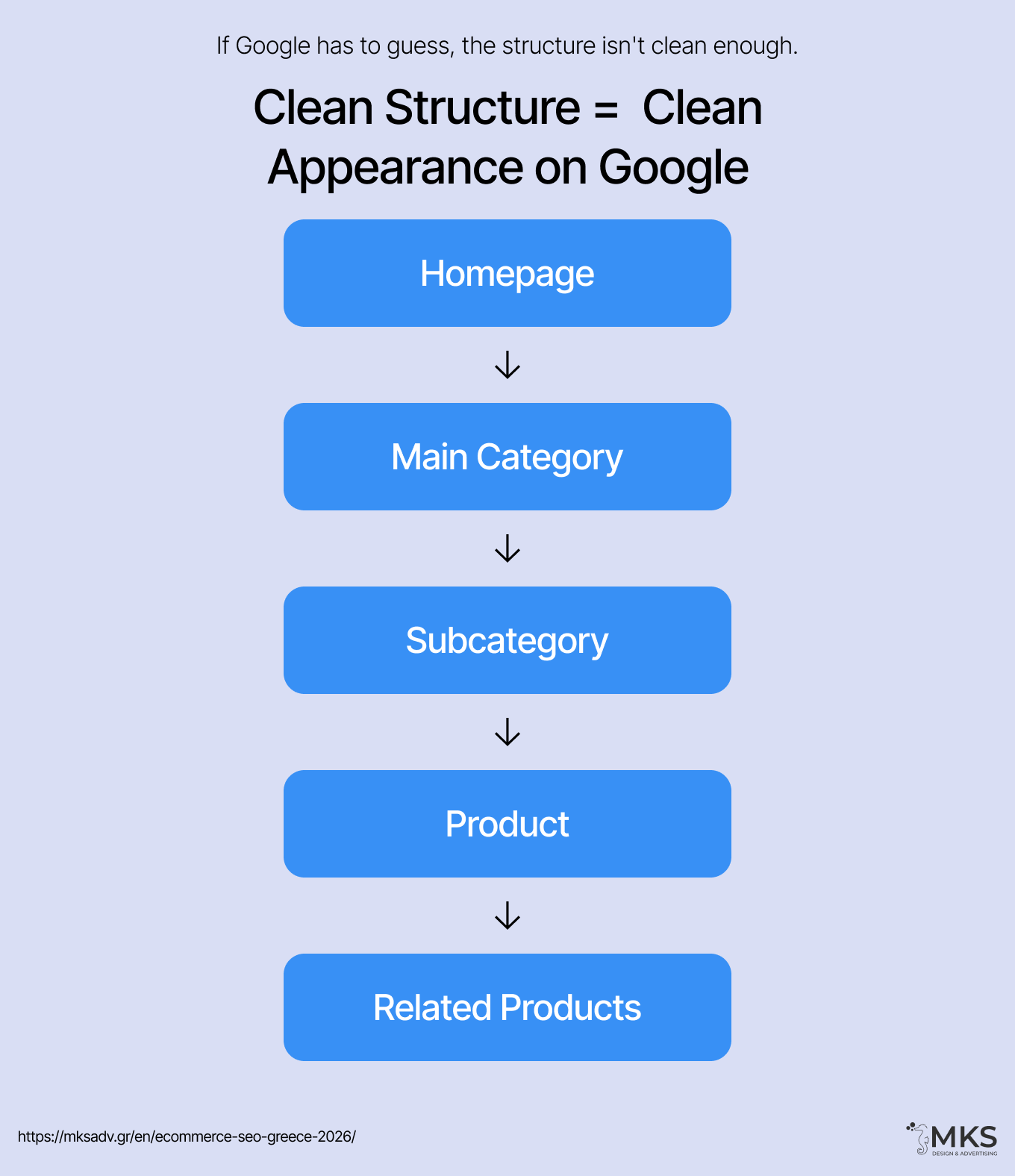
Before touching individual pages, the structure of the eShop needs to make sense. Main categories, subcategories, and products should follow the way the customer thinks, not the way a warehouse system organizes SKUs.
A clear hierarchy, from homepage to main categories, then to subcategories and finally to products, gives Google a cleaner signal about what each page is about. It also helps the user move through the store naturally, without feeling trapped in a digital attic full of unlabeled boxes.
URL structure should also be descriptive and stable. A URL like /women-shoes/boots/ immediately gives information to both the user and the search engine. A URL full of IDs, parameters, and random numbers says almost nothing. Once a proper structure is defined, it should not be changed without correct redirects.
Internal linking is the invisible backbone of eCommerce SEO. Each product should connect to the correct category, each category should connect to its important subcategories, and each commercially important page should be supported by relevant content. It is not only about navigation. It is how value moves through the site.
Categories Are Not Shelves. They Are Landing Pages
A category page should not start and end with a product grid. To Google, an empty category looks like dozens of others. To the user, it explains nothing. To the brand, it wastes a chance to show knowledge.
Every key category needs a short, useful introductory text. Not filler written to squeeze in keywords. Real information: what the category includes, who it is useful for, what someone usually compares before buying, and which features matter.
If the eCommerce store sells shoes, the “women’s boots” category can explain types, materials, fit, seasonality, and styling options. If it sells professional equipment, the category can help the customer understand which option fits a specific use, space, or need. That information makes the page more useful and clearer.
Filters also need attention. Filters improve user experience, but if they create uncontrolled indexable URLs, they can fill the site with thin or duplicated pages. There needs to be a clear strategy for canonical tags, indexation, and which filtered pages truly deserve to appear on Google.
Product Pages Are Decision Points
The most common mistake on product pages is using the same description provided by the manufacturer or distributor. The same text appears on many stores, so Google has little reason to choose your page over another one.
You do not need to rewrite thousands of products in one week. You need prioritization. Start with the products that generate the most sales, have the highest value, or have the strongest chance of bringing organic traffic. Even one original paragraph can make the page more useful.
A good product description does not simply say what the product is. It explains when it is used, who it is right for, what the customer should pay attention to, and why this specific choice makes sense. This is where trust is earned, especially in categories where users compare many similar options.
Title tags and meta descriptions also need to work at scale. A generic template like “Product Name | Store Name” is better than nothing, but it misses opportunities. A smarter template can use brand, product type, key feature, gender, use case, or material depending on the category.
On mobile, the product page must be fast, clear, and direct. Images should load properly, the buy button should be easy to find, and key information should not be buried under endless scrolling. The buying experience and the SEO experience now touch each other.
Structured Data: The Technical Foundation of eCommerce SEO
Structured data, also known as schema markup, is the way an eCommerce store tells search engines more clearly what exists on a page. Instead of leaving Google to infer that a page contains a product, price, availability, or reviews, structured data gives it organized information.
For eCommerce, Product schema is core infrastructure. It can help Google better understand details such as price, availability, reviews, shipping information, and return information. When the requirements are met, these details may appear more richly in search results.
This is not advanced SEO. It is technical hygiene. Most eCommerce platforms can support it through the right configuration, plugin, or theme implementation. The difficult part is not always the code. It is checking whether the data is correct, complete, and consistent with what the user actually sees on the page.
What About AI Search?
Search is changing. Tools and experiences such as ChatGPT, Gemini, Perplexity, and Google AI Overviews influence how users discover information, compare options, and arrive at recommendations. For eCommerce stores, this means visibility will not depend only on classic organic rankings.
There is no magic trick for AI visibility. The same foundations that make an eCommerce store easier for Google to understand also make its content clearer for AI systems: proper structure, unique descriptions, clear categories, schema, real information, reviews, and trust around the brand.
For Greek eCommerce, this is still a first-mover opportunity. Many stores have not built even the basics. So before we talk about AI search optimization, the foundations need to be fixed: someone should be able to understand what you sell, why they should trust you, and which page answers which need.
AI search does not cancel classic SEO. It makes it stricter. If a page has no structure, no experience, and no real usefulness, it does not have enough value for the user or for the system trying to assemble an answer.
What to Fix First If You Only Have 5 Hours This Week
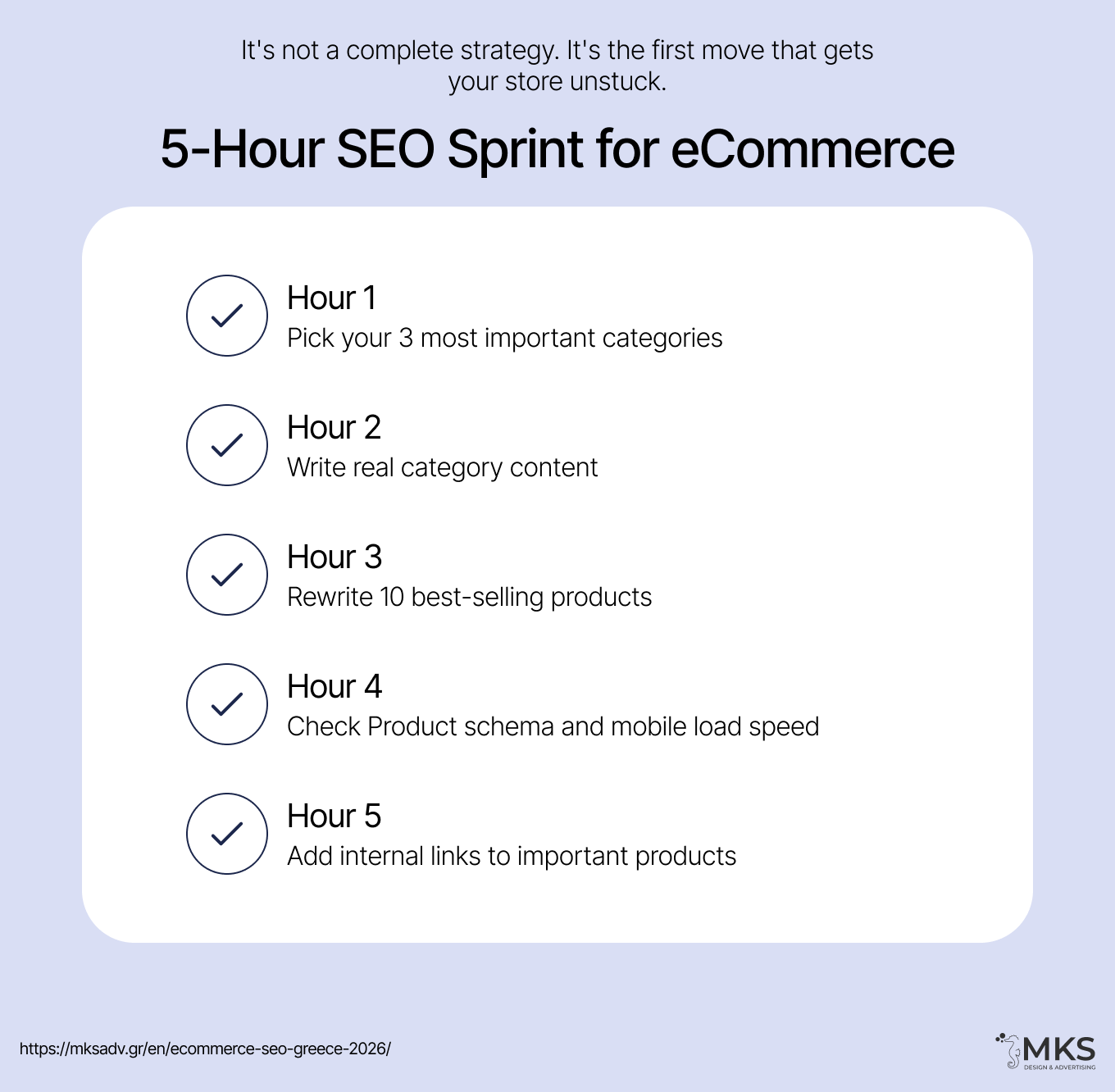
At MKS, we prefer priorities over endless lists
An eCommerce store can always find one more thing to fix, but not everything has the same value. That is why we start from the points that can influence organic visibility and buying experience more directly: key categories, commercially valuable products, speed, structure, and clear information.
If time is limited, do not try to “do SEO” for the entire store. Start with the pages that are most likely to create an impact.
This is not a complete SEO strategy. But it is a meaningful first move. Most stores stay invisible because they wait for the perfect project instead of fixing the pages that already matter.
Frequently Asked Questions
Does listing products on Skroutz hurt my SEO on Google?
Not directly. The problem is not being present on Skroutz. The problem is when the store invests only in the marketplace and leaves its own website without content, structure, or a reason to rank.
How long does SEO for an eCommerce store in Greece take to show results?
Usually, it takes 3 to 6 months to see meaningful movement, depending on competition, domain age, technical condition, and how consistently improvements are made. The best results build cumulatively over time.
Do I need to rewrite all my product descriptions?
No. Start with the products that already have commercial value. Top products and key categories come first. Then you can gradually move toward lower-priority products.
Do I need structured data if most of my traffic comes from paid ads or Skroutz?
Yes. Structured data is not only for organic traffic. It is basic technical infrastructure that helps search engines better understand your product pages.
What is the single highest-impact fix for a small Greek eCommerce store?
Usually, the biggest opportunity is found in the key categories and products that already sell. If those pages have empty or copied content, the first job is to give them real, useful information.
Ready to See Where Your eCommerce store Is Losing Organic Visibility?
For us, SEO in an eCommerce store is not a separate task that gets added at the end. It is part of how the store is designed, organized, and improved. When structure, content, and technical foundations work together, the eShop does not depend only on ads or marketplaces. It starts building its own organic presence.
If you want to see where your eCommerce store is losing organic visibility, the MKS team can review its structure, categories, product pages, and the key technical points that affect performance.