Yes, it can. You write two sentences, and a few minutes later you have an AI-built website: headline, photos, buttons, a contact form. It looks finished. Often it looks better than you expected.
The temptation makes sense. If it is this easy, why pay for a website? The answer has nothing to do with day one. It has to do with every day after it.
Day one is the easy part
Think of a shop. The fit-out takes a few weeks and the result is visible straight away. The hard part is running the place: prices change, opening hours change, new products arrive, something breaks, and someone has to hold the keys.
A website works the same way. AI is excellent at the fit-out. What you will not see on screen on day one is what happens when the site has to live for two years and change along with your business.
There are also things a first look does not show. A contact form can look perfect and never send an email to your office, or fill with spam within a week. Page titles and descriptions, the text Google reads, are often missing or identical on every page. A cookie notice is not optional in Europe once a site uses tracking tools, and it rarely comes with the prompt. Photos can be heavy enough to make the site crawl on a phone.
None of this is unsolvable. Someone still has to check it, and if nobody does, you find out from the customer who never got a reply.
The first thing that gets hard is changing something
The season is coming. Prices change, hours change, a new offer goes up. If your menu is printed, every change means a reprint. If it is a board you write on with a marker, you change the line and you are done.
Take one concrete change: a coffee goes from €3.50 to €4.00. On the printed-menu site, someone has to open the code, find the price, test it and upload the site again. In our example that takes about three days. With an admin panel, the person running the shop makes the change the same day. The timings are illustrative and depend on who picks up the job, but the difference in logic stays the same: in one case you wait for a person, in the other you do not.
Websites split into the same two groups. A “static” site is the printed menu: a ready-made set of files that looks great, but to change a price someone has to open the code and upload it again. A site with a CMS, such as WordPress, is the board. It has an admin panel, and text, prices and photos change from there, with no code and no waiting for a developer.
A site that comes out of two prompts is usually the printed menu: the text and prices are written inside the code. WordPress, on the other hand, runs on 38.5% of websites worldwide, according to W3Techs, and it was built precisely so that people can change their own content.
What if you ask AI to build the admin panel too?
It is the logical next question, and the answer is that it can be done, but it swaps the problem for another one instead of solving it. An admin panel is not a screen with a few forms. It needs a login, roles that decide who can change what, a database, backups, and security updates when a hole is found.
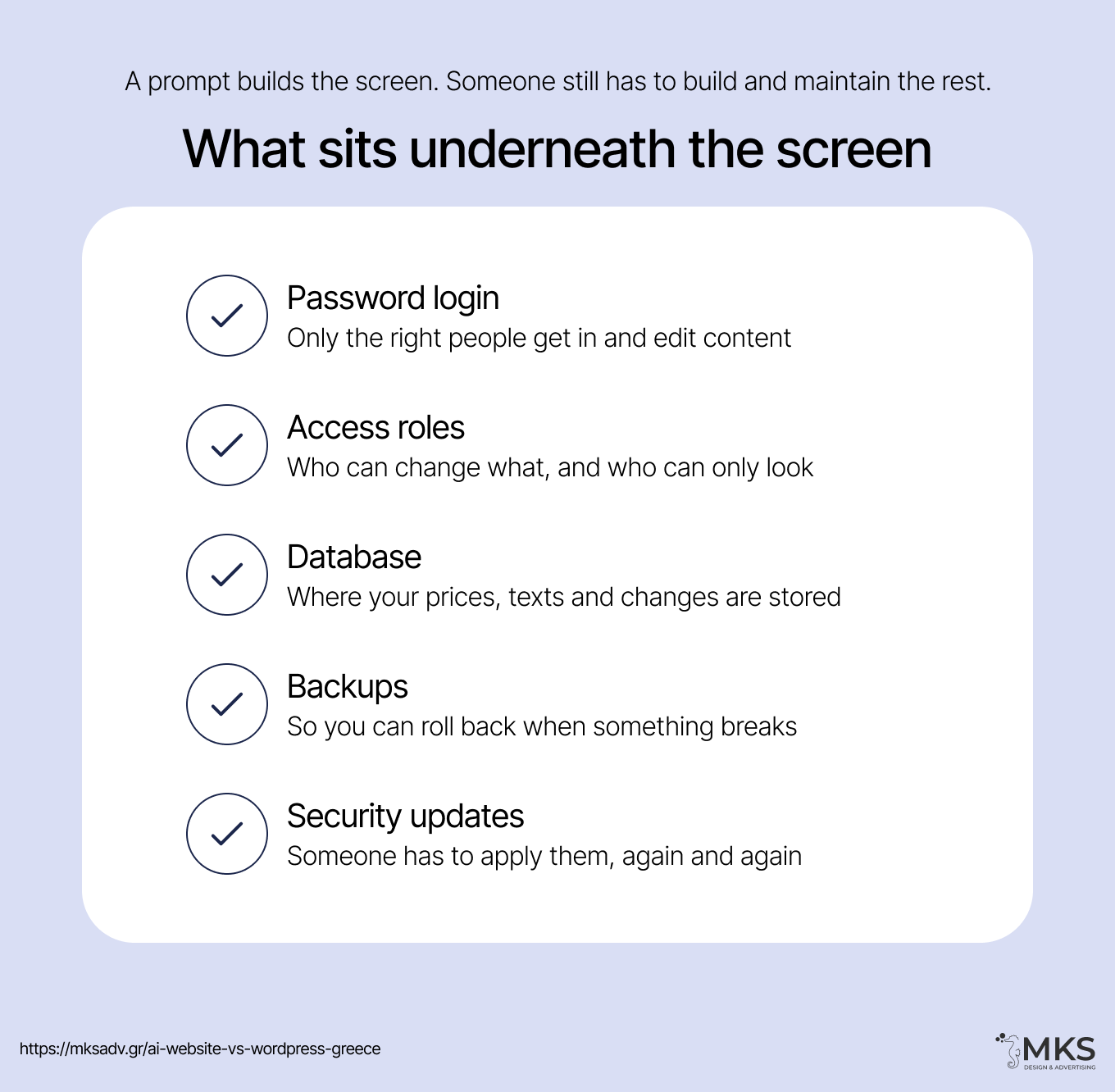
A prompt builds the screen. Someone still has to build and maintain the rest.
WordPress already has all of that, tested across a very large part of the web and maintained by people who have done it for years. A system written yesterday from a prompt has no such history. It may work, and it may also have a security hole nobody notices until someone else finds it. You have no way to tell the two apart.
There is a simpler route: have AI build the site on top of a CMS. That way it does what it does well, the design and the content, and the system that holds the keys is already in place.
One more question remains: what if AI stops being so cheap, or stops working? If the only way to change your site is to ask a tool to rewrite the code, you depend on that tool’s price, terms and availability, and you control none of them. A CMS admin panel works without any AI tool, and anyone who can type a sentence can use it.
When the printed menu is enough
It is not a bad choice. A page for a campaign, an event or an offer that ends in two months does not need an admin panel. It loads fast, hosting costs little and there is nothing to maintain. At MKS we build pages like this, and for them static is the right call.
An event page is a good example: it lives for a few weeks, has a schedule that does not change and a sign-up form, and then comes down. Paying for an admin panel there would be a cost with no reason behind it.
One test decides it: will the content change? If not, static is enough. If yes, you need an admin panel, and content usually changes more often than you expect.
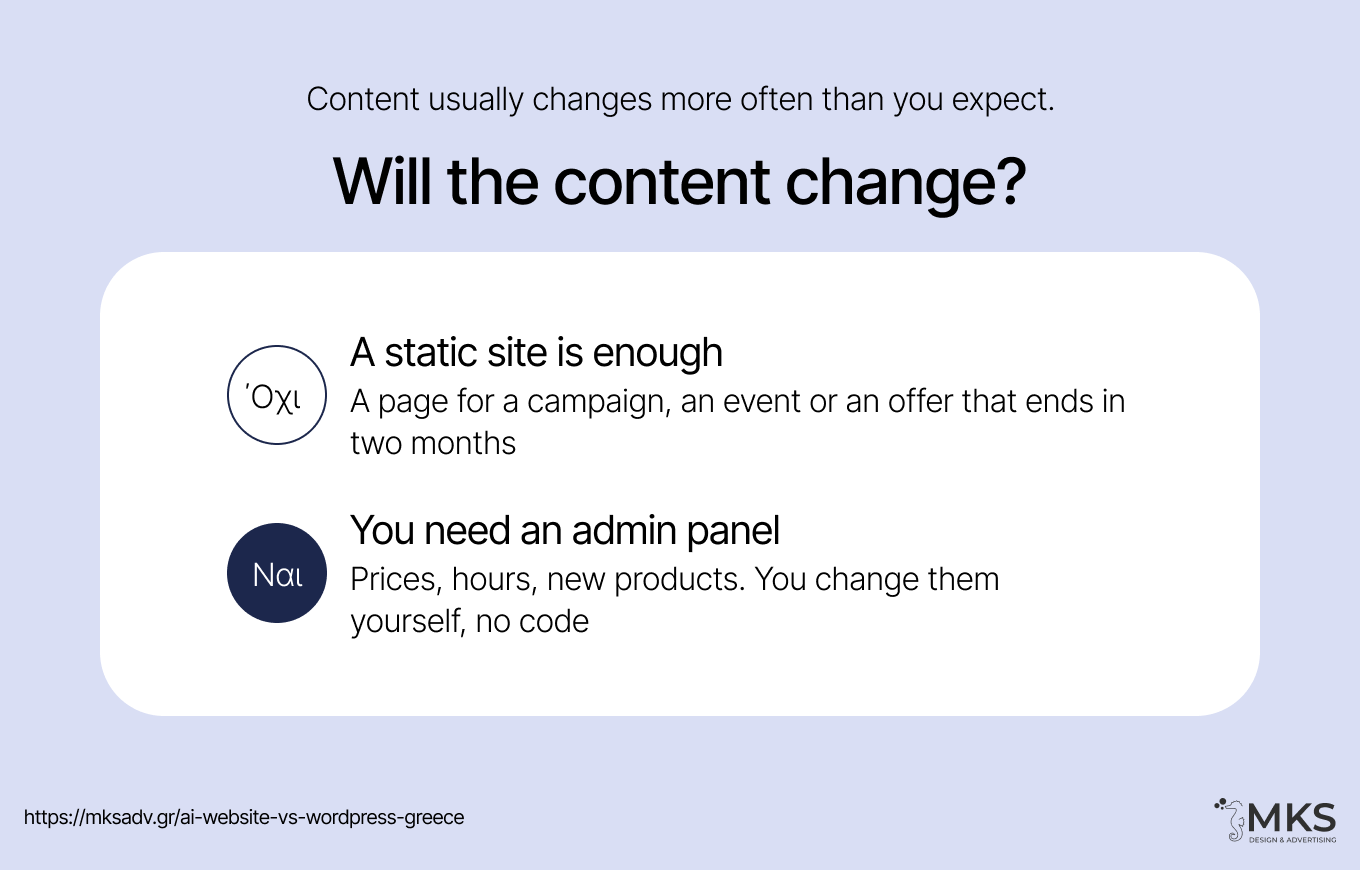
The answer to that one question separates the two cases.
What WordPress asks of you in return
To be fair, the admin panel has a cost too. WordPress needs updates to the core, the theme and the plugins, and a plugin that has not been updated in years is one of the most common ways a site gets compromised. The hosting has to be decent, or the site slows down. Some plugins carry an annual subscription.
A static site has none of that. It has no database to breach and no plugin to forget. That is why the right comparison is not free against paid. It is two different ways of paying: with one you pay for the care of the site, with the other you pay for every change.
| Static site | Site with a CMS (e.g. WordPress) | |
|---|---|---|
| Changing a price | Someone opens the code and uploads the site again | You do it yourself from the admin panel |
| Upkeep | Almost none | Updates to the core, the theme and the plugins |
| Database | None | Yes, with backups |
| What you pay for | Every change | The care of the site |
| Fits | A campaign or event page | A site that changes often |
Four questions before you decide
Whoever builds the site, a person or a tool, these questions show quickly what you are getting. First, who changes a price, and what does it cost each time? Second, whose name are the domain and hosting registered in? Then, where are the text and images stored, and can you take them with you? And finally, what happens if the person who built the site stops maintaining it?
The second question surprises more people than you would expect. If the domain is registered in the name of the developer or the agency that built the site, that person controls where your name points. One disagreement or one departure, and your business address is no longer yours.
If you are building the site with AI, put it in the prompt explicitly: you want an admin panel where you can change text, prices and photos yourself. And do not take the first result on trust. Try changing a price before you publish.
A well-built site has simple answers: you make the changes, from an admin panel, and everything is in your name. If you are not sure what yours needs, tell us what it will show and who will update it, and we will tell you what fits.