


Most Greek online stores were built for one job: showing up on Skroutz with a competitive price. That worked for years, and in a narrow sense it still works. But a store that only exists inside someone else’s marketplace never builds anything of its own, and 2026 is an unforgiving year to find that out.
This guide walks through what e-commerce marketing actually requires for a Greek retail brand right now: where the market came from, why Skroutz can’t be the whole plan, what shoppers expect before they hand over a card number, and what a product page ready for AI search actually looks like.
The Three Eras of Greek eCommerce
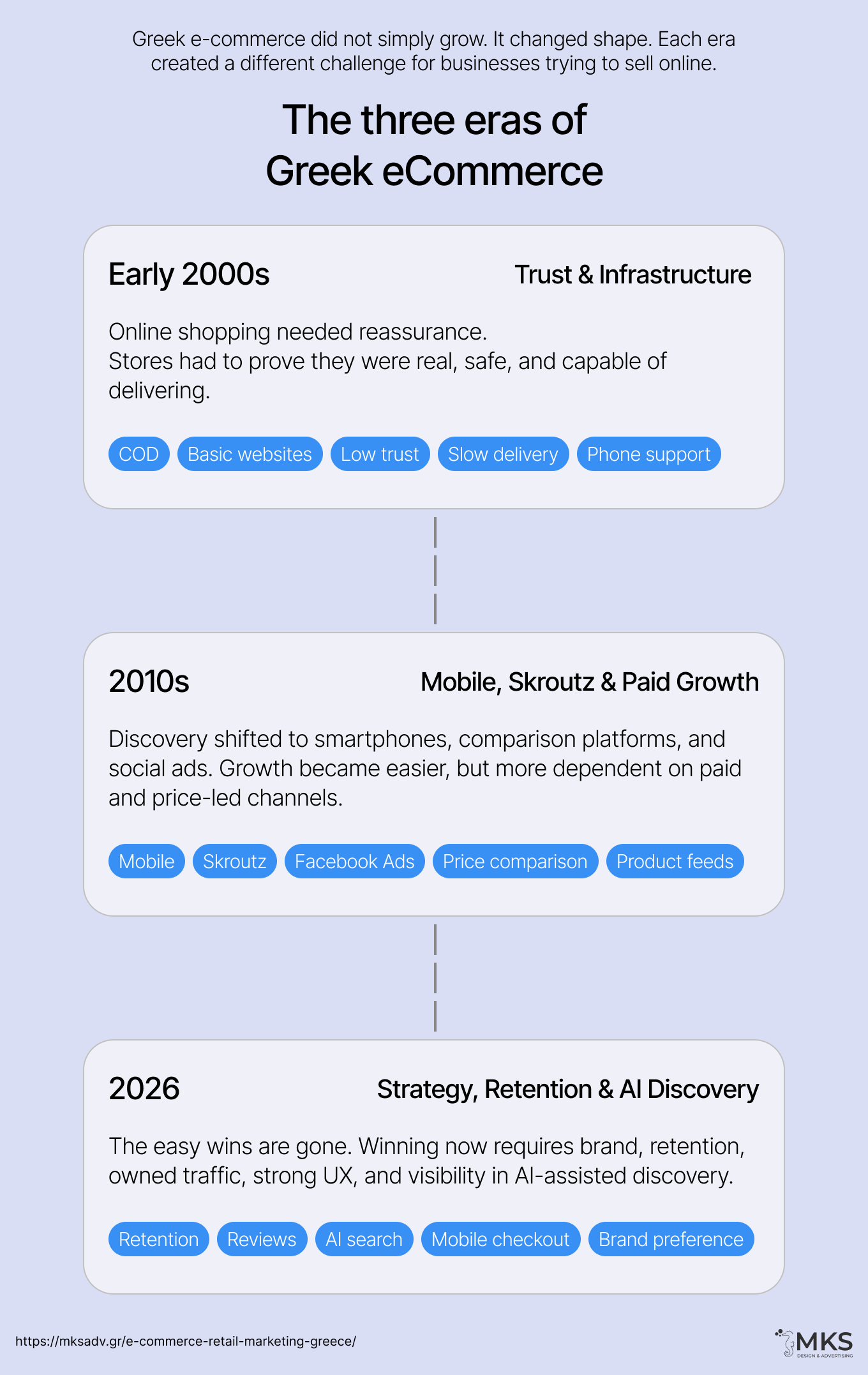
Give Greek e-commerce a timeline and it splits into three periods. None of them fully ended. Pieces of all three are still running today, sometimes on the same website.
The first was skeptical. Cash on delivery covered a large share of orders because people didn’t trust a Greek website with their card details, and plenty of stores gave them good reason not to. Product pages were thin, checkout was a hassle, and most owners treated the website as a digital catalog rather than a sales channel.
The second period had a name: Skroutz. Price comparison and marketplace platforms gave small stores a fast way to reach buyers who were already comparing prices, and for a lot of retailers that became the entire growth plan. It worked. It also meant the store’s own website stopped mattering as much, because the traffic, the trust, and the price comparison all happened somewhere else.
The market has grown past that point. Greek e-commerce retail is worth roughly €3.5 billion a year, according to Statista, and growth hasn’t slowed even as acquisition costs have risen across every channel. The third period is the one most stores haven’t caught up to yet: a mix of paid search, organic visibility, and increasingly, AI-generated answers deciding which products even get considered before a shopper opens a single website.
One shift cuts across all three periods and keeps accelerating: mobile. A store built for a desktop screen in 2016 is fighting its own customers today, because the large majority of Greek retail traffic now arrives on a phone, often on a connection slower than what the site was tested on.
Skroutz Is a Channel, Not a Strategy
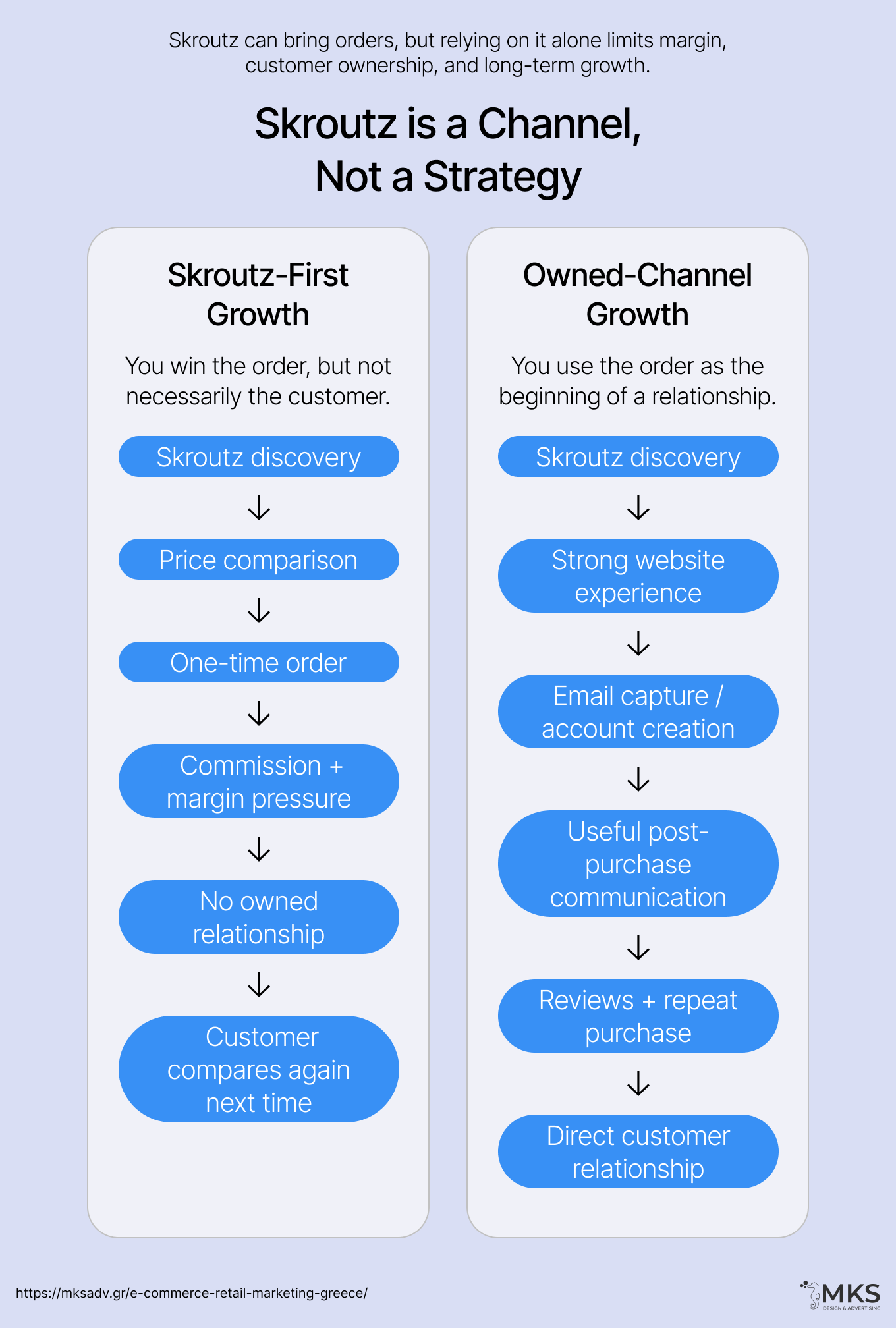
None of this makes Skroutz a bad channel. For a large share of Greek retailers it is still the single biggest source of sales, and pretending otherwise would be dishonest. The problem shows up when it’s the only channel, because a marketplace listing is rented space.
Skroutz sets the rules, takes a commission, and can change its ranking logic whenever it decides to. Stop paying for placement and the traffic drops the same week. A competitor undercuts the price by two euros and the listing falls a page down. None of that sits under the store’s control, and none of it builds anything that belongs to the business once the relationship with the platform shifts.
Compare that to a customer who found the store through Google, read a product page that actually answered their question, and bought without touching a comparison engine. That customer’s data, the repeat-purchase potential, the email address: all of it belongs to the store. It compounds. A Skroutz sale mostly doesn’t.
Building an Acquisition Mix That Doesn’t Depend on One Platform
Diversifying away from a single channel doesn’t mean abandoning it. It means building two or three more legs under the business, so a bad month on one platform doesn’t threaten payroll.
Attribution gets messier as the mix grows, and that’s worth accepting up front rather than fighting. A customer might see a product on Meta, search for it on Google two days later, and buy it directly after an email reminder. Whichever channel gets credited last, all three did real work. Chasing a single source of truth here usually wastes more time than it saves; tracking the trend across channels matters more than crediting one perfectly.
Google Ads and Meta Ads give controllable, immediate volume, at a cost. Search ads catch people who already know what they want and are deciding where to buy it. Meta ads work earlier, when someone hasn’t started looking yet but might respond to the right product at the right moment. Both need real budget discipline. A campaign nobody checks for three weeks is money quietly disappearing.
Organic search moves slower and asks for more patience than most owners want to give it. A category page that ranks well for a specific, high-intent search term doesn’t cost anything per click. It also took months of real content and site structure work to get there, and it keeps paying off long after a paid campaign would have been switched off.
Email sits underneath all of it, and most Greek stores treat it as an afterthought. A single abandoned-cart sequence, sent to someone who already put items in a basket and left, routinely recovers sales that paid acquisition spent real money chasing in the first place.
Influencer and affiliate partnerships sit somewhere between paid and organic, and Greek retail brands underuse both compared to markets like the UK or the US. A handful of the right micro-influencers, people with a genuinely engaged few thousand followers in a relevant niche, often outperforms a much larger campaign built around someone chosen purely for follower count.
Payments, Returns, and the Local Details That Actually Decide the Sale
A generic e-commerce guide written for a US or UK audience misses half of what decides a sale in Greece. Payment method, delivery partner, and return policy carry more weight here than in markets where card payment and next-day delivery have been the default for two decades.
Cash on delivery still accounts for a meaningful share of Greek online orders, particularly outside Athens and Thessaloniki and outside younger age groups. Refusing to offer it isn’t a modernization move. It’s a way to lose a real segment of buyers who haven’t finished trusting card payments online, sometimes for good reason given how many low-quality stores exist. A store offering COD alongside card and installment options through a Greek gateway, Viva Wallet or the equivalent from a Greek bank, covers the actual range of how people want to pay, not the range a template assumed.
EU distance-selling rules give shoppers a 14-day right of withdrawal on most online purchases, and Greek consumers know this rule reasonably well. A return policy that’s vague, hidden three clicks deep, or shorter than what the law requires reads as a red flag before a shopper even adds something to the cart. Stating the return window clearly, along with who pays for return shipping, removes one of the last hesitations before checkout.
Delivery partner matters more than most stores think about. ELTA Courier, ACS, Speedex, and locker networks like BOX NOW each carry different expectations around speed, tracking quality, and how often a package actually shows up when promised. A store that picks a courier on price alone, without checking delivery reliability in the areas its customers actually live, pays for that decision in refund requests and one-star reviews.
What Online Shoppers in Greece Actually Expect in 2026
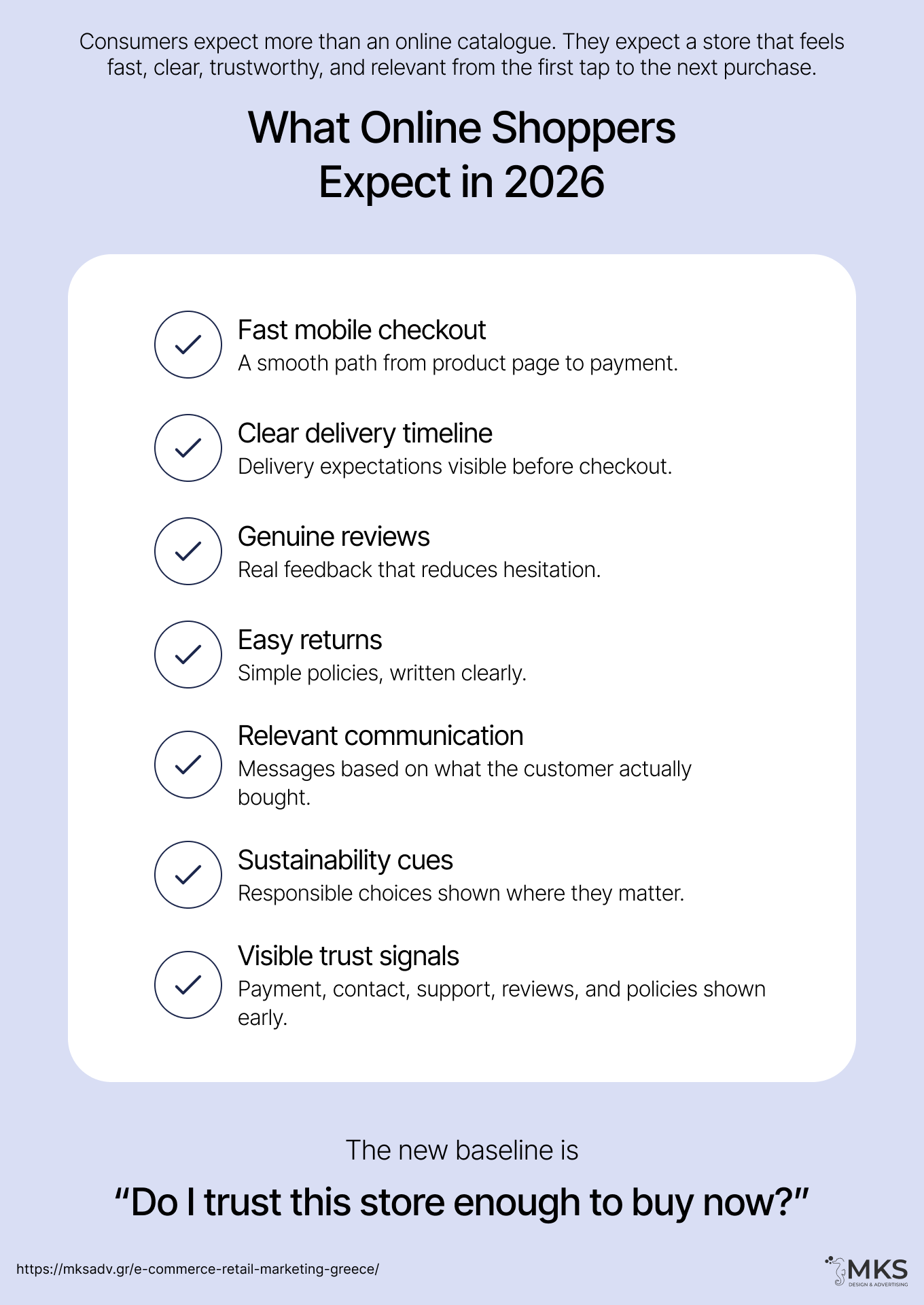
Expectations moved fast. A shopper in Athens comparing two stores isn’t grading them against local competitors anymore. She’s grading them against Zalando, against Amazon’s checkout, against whatever app she used yesterday. The bar is international even when the store is local.
Mobile is where most of that comparison happens, and mobile is where most Greek stores still lose the sale. A checkout that asks for eight fields on a phone screen, a buy button sitting below three scrolls of specifications nobody reads, images that load slowly on a train connection: each one is a shopper closing the tab and buying from whoever made it easier.
Trust signals matter more than most owners assume. Real customer reviews, a visible return policy, a phone number that actually gets answered: these decide whether someone hands over a card number to a store they’ve never used before. A Greek shopper burned once by a slow delivery or a fake review doesn’t come back to find out if it was a fluke.
Delivery expectations have shifted too. Same-day or next-day delivery used to be a nice-to-have. For a growing share of shoppers it’s the deciding factor between two nearly identical listings. A store that can’t communicate a realistic delivery window clearly loses the sale to one that can, even at a slightly higher price.
Social proof does more work than most product pages give it credit for. A handful of real photos from actual buyers, visible star ratings, and a comment thread that isn’t suspiciously perfect all signal the same thing: other people bought this and didn’t regret it. A store with zero reviews on every product looks, to a 2026 shopper, like a store that hasn’t sold much, whether or not that’s true.
Is Your Product Page Ready for AI Search?
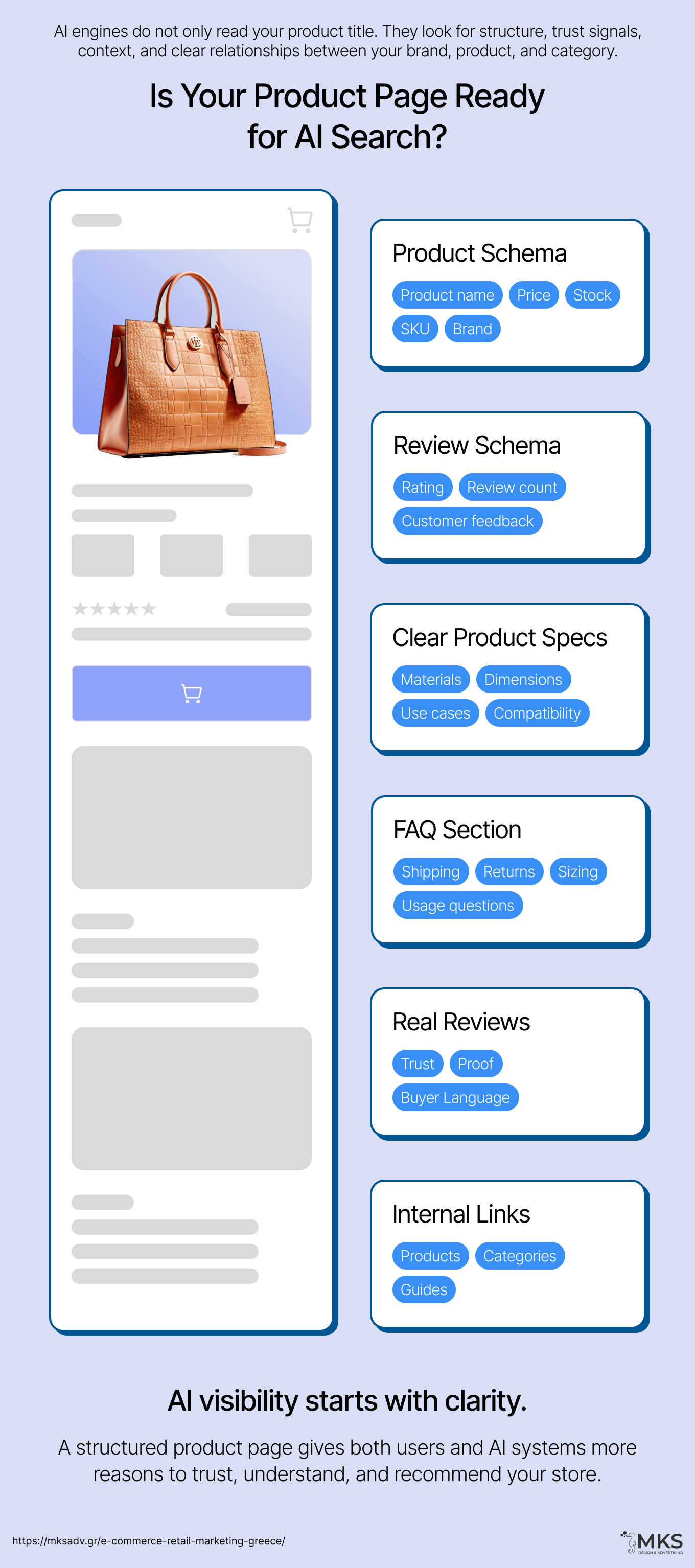
Search itself is changing shape. Google’s AI Overviews, along with tools like ChatGPT and Perplexity, now sit somewhere in how people research a purchase before they ever land on a store’s website.
Google has described how these AI features pull from and summarize web content directly inside the search results, which means a product page has to be legible to a system, not only to a person scrolling.
None of this replaces the fundamentals. A page with vague specs, no reviews, and a description copied from the manufacturer’s catalog gives an AI system nothing worth citing, for the same reason it gives a human shopper no reason to trust it. Structured data, specifically Product schema, is what tells search engines and AI systems the price, availability, and specifications directly, instead of asking them to guess.
For most Greek retail brands, this is still an open window. Few competitors have fixed their basic product page content, let alone thought about how an AI system would summarize it. Getting the fundamentals right now, clear descriptions, working schema, real reviews, puts a store ahead of competitors who will eventually have to catch up anyway.
There’s a second-order effect worth watching too. As more purchase research moves into a chat interface instead of a search results page, the products that get mentioned by name are the ones with enough public information for the system to be confident about. A product with three data points scattered across the web loses to a competitor with a complete, consistent picture: same spec sheet on the site, in reviews, and in any press or marketplace listing that mentions it.
Retention Economics: Why the First Sale Isn’t the Goal
Acquisition gets all the attention because it’s visible. Someone runs an ad, a sale happens, the line goes up on a dashboard. Retention is quieter, and it’s usually where the real margin sits.
A customer who buys once through a Skroutz listing costs the same, or more, the second time, because the platform takes its cut again. A customer who buys directly, and comes back because the experience was good and the email sequence reminded them at the right moment, costs almost nothing on the second and third purchase. That’s the entire argument for retention: acquisition cost gets paid once, and everything after that is close to pure margin.
Most Greek stores don’t track customer lifetime value at all, so they can’t see this. They know cost per acquisition, sometimes. They rarely know what a customer is worth across a year, which means every channel decision gets made on the wrong number.
A basic retention setup doesn’t need to be complicated to work. A welcome sequence for new subscribers. A post-purchase sequence timed to when the product typically runs out or needs replacing. A win-back email for anyone who hasn’t ordered in four months. None of it is advanced marketing. Almost nobody does it consistently.
The math is straightforward once it’s written down. Acquiring a customer through paid search or a marketplace listing might cost fifteen to twenty-five euros, depending on the category. That same customer’s second purchase, driven by an email sequence that costs close to nothing to send, effectively costs a fraction of that. Run that across a few thousand customers and the gap between a store that retains and a store that doesn’t stops being a rounding error.
Acquisition Channels, Side by Side
No single channel covers everything a Greek retail brand needs. Each one trades speed for ownership in a different way.
| Channel | Who owns the relationship | Cost behavior | Time to results | Biggest risk |
| Skroutz / marketplaces | The platform | Pay per sale, rises with competition | Immediate | Platform controls rules and visibility |
| Google Ads | The store, partially | Pay per click, scales with spend | Fast (days) | Costs rise; stops the moment budget stops |
| Organic SEO | The store, fully | Time and content investment, low marginal cost | Slow (months) | Needs sustained effort; exposed to algorithm shifts |
| Email / retention | The store, fully | Near-zero marginal cost per send | Fast, on an existing list | Only works if the list exists and stays engaged |
Frequently Asked Questions
Is Skroutz still worth using in 2026?
Yes. For most retail categories it remains one of the highest-volume channels in Greece. The mistake isn’t using it. It’s building nothing outside of it.
How much of my e-commerce budget should go to paid ads versus organic?
There’s no fixed ratio that works for every store. A useful rule: keep paid spend high enough to fund what organic and retention haven’t built yet, and lower it as those channels start carrying more weight.
Do I need a mobile app, or is a mobile website enough?
A well-built mobile website covers almost every Greek retail brand’s needs. An app makes sense once repeat purchase frequency and customer volume justify the extra development and maintenance cost, which is a smaller group of stores than most owners assume.
What’s the fastest way to reduce dependence on Skroutz?
Start with email. It’s the cheapest channel to set up, and a basic abandoned-cart and win-back sequence usually pays for itself inside the first month.
How long does it take to see results from organic SEO for a Greek eShop?
Typically three to six months before meaningful movement, depending on the store’s technical condition, competition, and how consistently the work continues.
Does AI search actually send traffic to product pages yet?
It’s early, and it’s growing. The bigger point is that AI systems are already shaping which products get considered before a shopper visits any website, so getting product pages ready now is preparation, not chasing a trend that hasn’t arrived.
What single change would have the biggest impact for a small Greek retailer right now?
Usually retention. Most small stores have already paid to acquire their existing customers once. A basic email sequence gets a second and third purchase out of people who were never going to come back on their own.
Should a small store bother offering cash on delivery if it adds operational cost?
For most categories, yes, at least for now. It’s not a preference to accommodate, it’s a real segment of buyers who won’t complete a card payment on an unfamiliar site. A small prepaid discount tends to shift volume over time without cutting off the customers who aren’t ready to switch.
Where MKS Fits Into This
We build and run e-commerce marketing for Greek retail brands that are past wanting one clever tactic. Site structure, acquisition mix, retention, and getting product pages ready for how people actually search now: it’s one connected system, not four separate projects handed to four different vendors.
If you want a clear look at where your store is losing revenue, whether that’s an overreliance on one channel, a checkout losing mobile shoppers, or product pages that don’t hold up next to competitors, the MKS team can walk through it with you. No package pitch before that. Just an honest look at where the money is actually leaking.