


Building an effective eCommerce Greece strategy in 2026 means navigating a market that has changed faster than most people running online stores have had time to notice. The rules that applied even three years ago, cheaper traffic, lower consumer expectations, limited competition in most categories, have been replaced by something considerably more demanding.
This is not a warning designed to discourage. Greek eCommerce is still growing, and in several categories there is genuine room for new players to establish a strong position. But the nature of the opportunity has shifted. Understanding that shift is the starting point for building a strategy that holds up.
This guide covers the arc of Greek eCommerce from its early days through to the current moment, the structural changes in consumer behaviour and market dynamics, and what the stores that are actually growing in 2026 are doing differently.
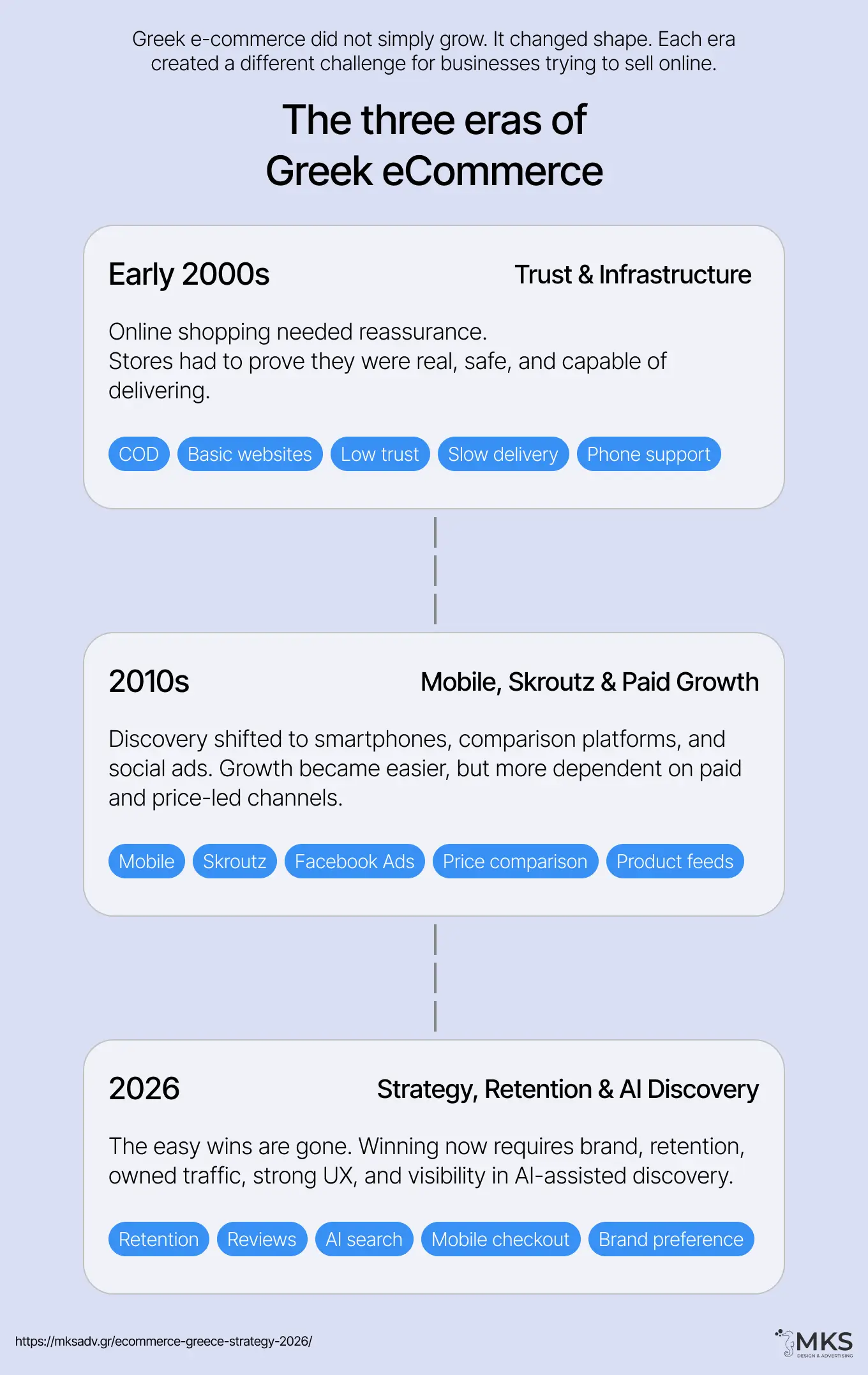
What Greek eCommerce looked like in the early years
Greek eCommerce in the early 2000s was a small, cautious world. Consumer trust in online transactions was extremely low. Most buyers were unwilling to enter their card details on a website. Cash on delivery was not a convenience option — it was often the only option that could close a sale.
The logistics infrastructure to support eCommerce did not really exist in any reliable form. Deliveries were slow, tracking was unreliable, and returns were an afterthought. The entire proposition, buy something you cannot touch from a company you cannot visit, required a level of trust the market had not yet built.
The stores that survived and grew in this period did so by building that trust slowly and manually. Many of them were extensions of existing physical retail businesses, which gave them a name and a phone number that customers could verify. Pure-play online stores were rare, and the ones that existed operated in categories where physical touch mattered less: books, software, electronics components.
For an advertising agency working with Greek clients in this period, the conversation was less about strategy and more about infrastructure. Does your store actually work on mobile? Do you have a reliable payment gateway? Does your returns policy exist somewhere customers can actually find it? The baseline questions were the whole conversation.
The shift that happened in the 2010s
The 2010s changed the Greek eCommerce market in ways that felt gradual at the time but look dramatic in retrospect. Three forces drove the transformation: smartphones, Skroutz, and Facebook advertising.
Smartphones moved browsing – and eventually purchasing – onto mobile devices. Greek consumers who had been hesitant to buy online on a desktop became comfortable completing transactions on their phones. The barrier was not the internet. It was the context. A phone felt personal and manageable in a way that a desktop computer did not.
Skroutz arrived as a price comparison engine and rapidly became the dominant discovery layer for product search in Greece. For many categories, particularly electronics, home goods, and fashion basics, it essentially replaced Google as the place where purchase intent was expressed. A product that was not listed on Skroutz was, for many consumers, a product that did not exist.
Facebook advertising opened the top of the funnel in a way that had never been accessible to small and medium Greek businesses before. You could build a product catalogue, set a budget, and reach a targeted audience with relatively little expertise. The first wave of Greek eCommerce brands that scaled quickly – mostly in fashion and beauty – did it largely on Facebook.
By the mid-2010s, Greek eCommerce had crossed a threshold. Consumer trust was established. Logistics had improved. The market had moved from whether this was viable to how to compete. That is a very different set of problems.
Where the Greek eCommerce market stands in 2026
The Greek eCommerce market in 2026 is a mature, competitive environment. Statista estimates Greek online retail revenue at close to €3.5 billion in 2025, with consistent year-on-year growth driven by categories that were minor ten years ago: health and wellness, outdoor and sport, pet products, home improvement. When broader online spending including travel and digital services is factored in, the total is substantially higher — but the retail core is where most independent stores compete.
Mobile accounts for the majority of sessions and a growing share of completed transactions. The consumer who browses on a phone and buys on a desktop still exists, but the gap is closing quickly. Stores that have not fully optimised for mobile purchase — not just mobile browsing — are losing revenue to friction they may not even be measuring.
Cross-border competition is now a structural reality. Greek consumers buying from Temu, Shein, and Amazon EU are not a niche behaviour. They represent a price-anchoring force that affects every category these platforms touch. A Greek fashion or home goods store is not competing only with other Greek stores — it is competing with global logistics operations that have spent years compressing their cost base.
At the same time, there are categories and positioning angles where local Greek stores have a genuine and durable advantage: local knowledge, faster delivery, Greek-language customer service, supplier relationships that global platforms cannot replicate, and in some categories a quality and authenticity story that resonates strongly with a specific customer profile.
The market is not stagnant. But it has become significantly more demanding. The businesses growing in 2026 are not doing so by accident or by default. They have made deliberate choices about positioning, channels, and investment.
The Skroutz dependency problem
Skroutz is not a problem. It is a powerful and effective channel, and most Greek eCommerce businesses should be on it. The problem is dependency: the store that treats Skroutz as its primary or exclusive source of customers has built a business on rented ground.
The economics of Skroutz dependency are worth stating clearly. When a customer discovers your product through Skroutz, the decisive variable in their purchase decision is price. You have won a transaction, but you have not won a customer. They do not remember your brand. They will return to Skroutz next time and compare again. Your margin has been compressed by the commission, and you have no data, no relationship, and no differentiation that survives the next comparison.
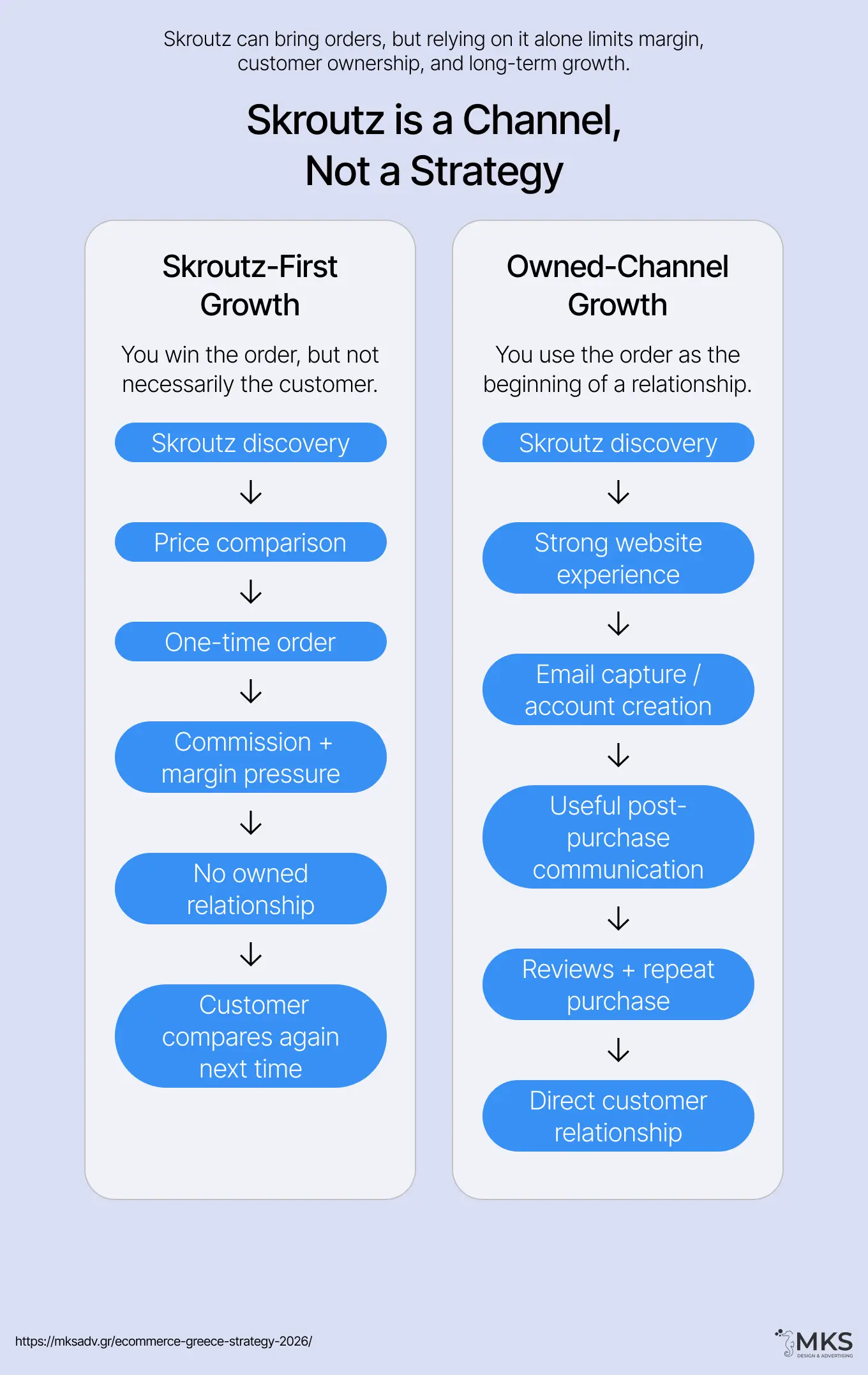
“When a customer discovers your product through Skroutz, the decisive variable is price. You have won a transaction, but you have not won a customer.”
This is not a hypothetical risk. It is the operating reality for a large share of Greek online stores. They are busy, they are processing orders, and they are not building anything. When Skroutz adjusts its algorithm, changes its fee structure, or a competitor undercuts them on price, they have nothing to fall back on.
The stores that have found a way out of this pattern share a common approach: they use Skroutz as a customer acquisition channel, but they invest in converting those customers into direct relationships. Email capture at checkout. Post-purchase communication that is genuinely useful rather than promotional. A website experience good enough to make a customer want to return without the intermediary.
That last point matters more than it might seem. If your website experience is noticeably worse than the Skroutz interface, slower, harder to navigate, less reassuring, customers will not come back directly even if they want to. The platform dependency is partly a technology problem.
What the 2026 Greek consumer actually expects
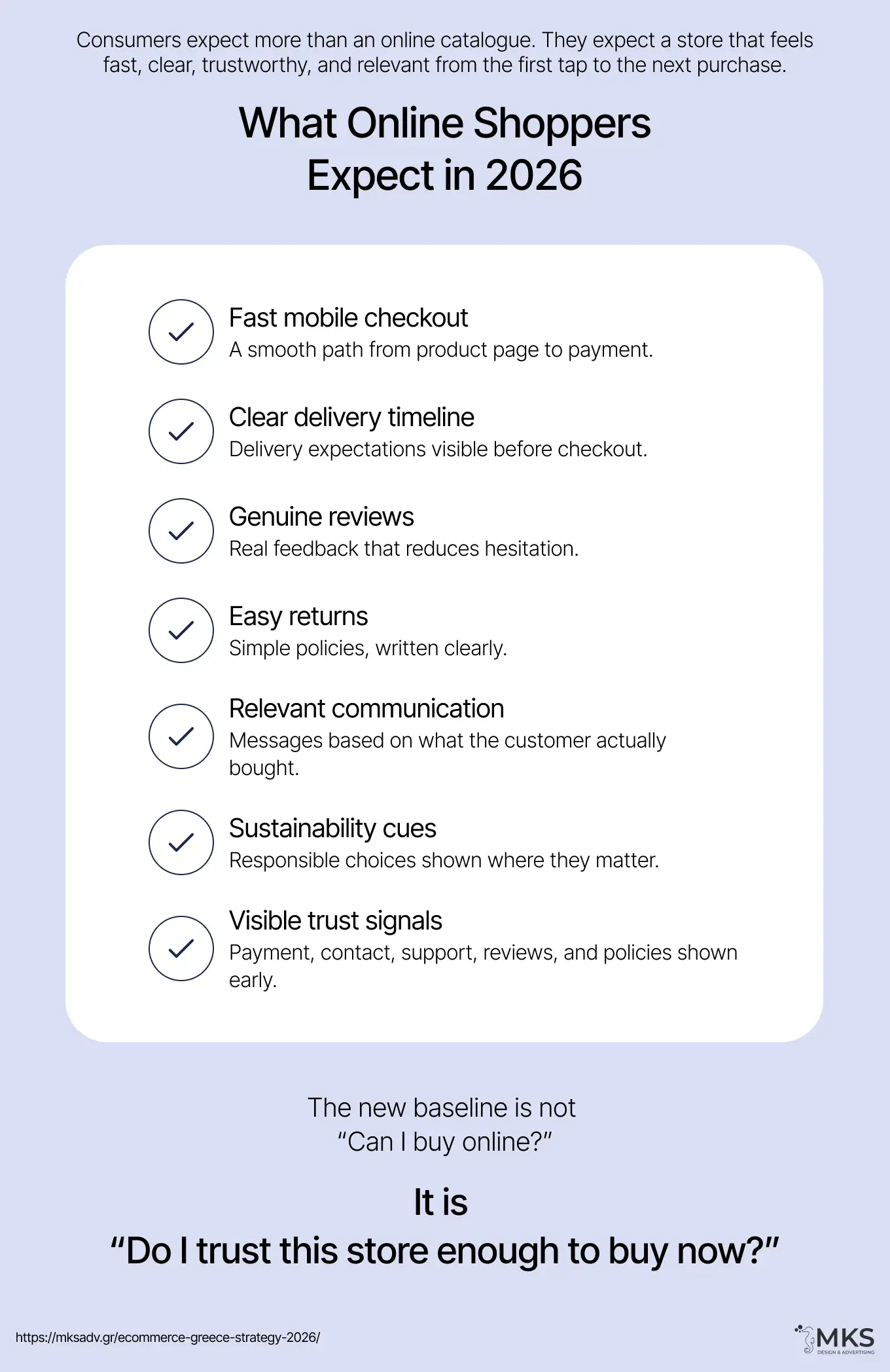
Consumer expectations in Greek eCommerce have converged significantly with European norms, and in some areas exceeded them. Speed and clarity are no longer differentiators — they are table stakes. A store that is slow to load, difficult to navigate on mobile, or unclear about delivery timelines is not being assessed against local competitors. It is being assessed against every online shopping experience that customer has ever had.
Trust signals have become more sophisticated. Early Greek eCommerce buyers needed basic reassurance: a phone number, a physical address, a recognisable payment logo. The buyer in 2026 wants to see product reviews that look genuine, clear return policies without hidden conditions, and delivery estimates they can rely on. Vague or optimistic delivery promises have a measurable impact on repeat purchase rates.
Social proof carries weight that brand advertising often does not. A Greek consumer who is unfamiliar with your brand will look for reviews on Google, Skroutz, or your own product pages before completing a significant purchase. The store that has invested in review generation has a structural advantage over the one that has not.
Sustainability language has moved from optional to expected in a growing number of categories. This does not mean every consumer prioritises it or is willing to pay a premium for it. It means that the absence of any sustainability positioning in categories where it is now standard is a signal that customers notice.
Perhaps the most important shift is the expectation of relevance. Greek consumers who have experienced personalised recommendations on major platforms now apply a version of that expectation to every commercial interaction. Email newsletters that read like broadcasts go unread. Post-purchase communication that ignores what the customer actually bought goes ignored.
What a serious eCommerce strategy in Greece requires today
The question is not what worked before. The question is what holds up under current conditions: saturated categories, rising acquisition costs, cross-border competition, and consumers who have more options and less patience than at any previous point in Greek eCommerce history.
Search visibility as a long-term asset
Organic search traffic is the only channel that compounds. Every well-structured product page, every category page built around genuine search intent, every piece of content that answers a real question — these are assets that continue working after the investment is made. Paid media scales, but it never builds equity. When you stop spending, it stops delivering.
“Organic search traffic is the only channel that compounds. Every well-structured product page is an asset that continues working after the investment is made.”
Greek eCommerce SEO in 2026 requires more than keyword placement. Search engine assessment of a product page now weighs page experience, structured data, review signals, and topical authority. A store that has published nothing except product listings is starting from a weaker position than one that has built genuine content around the categories it sells in.
Performance marketing that knows its limits
Meta and Google advertising still work in Greece. They work better for businesses that understand what they are for: acquiring new customers at a cost you can sustain. The trap is treating performance marketing as a growth strategy rather than an acquisition tool. When cost per acquisition rises — and it has risen significantly across most Greek categories in the past three years — a business that has built no other channel has no good options.
The businesses that are scaling profitably on paid media in 2026 are the ones that have disciplined acquisition cost targets, test aggressively rather than scale prematurely, and treat paid as one part of a system that also includes retention and organic traffic.
Retention as the profit layer
Greek eCommerce is underdeveloped in retention. Most stores invest heavily in acquisition and almost nothing in the period after the first purchase. This is a significant and recoverable mistake. The economics of repeat customers are consistently better than new customer acquisition: lower cost, higher average order value, higher lifetime value.
Email remains the most effective retention channel available to Greek online stores, and it is consistently underused. Not because stores do not have email lists – most do – but because they use them primarily for promotions. A welcome sequence, a post-purchase flow, a replenishment reminder for consumable products: these are not advanced tactics. They are basic infrastructure that most Greek stores have not built.
“Greek eCommerce is underdeveloped in retention. The economics of repeat customers are consistently better than new customer acquisition.”
AI search visibility
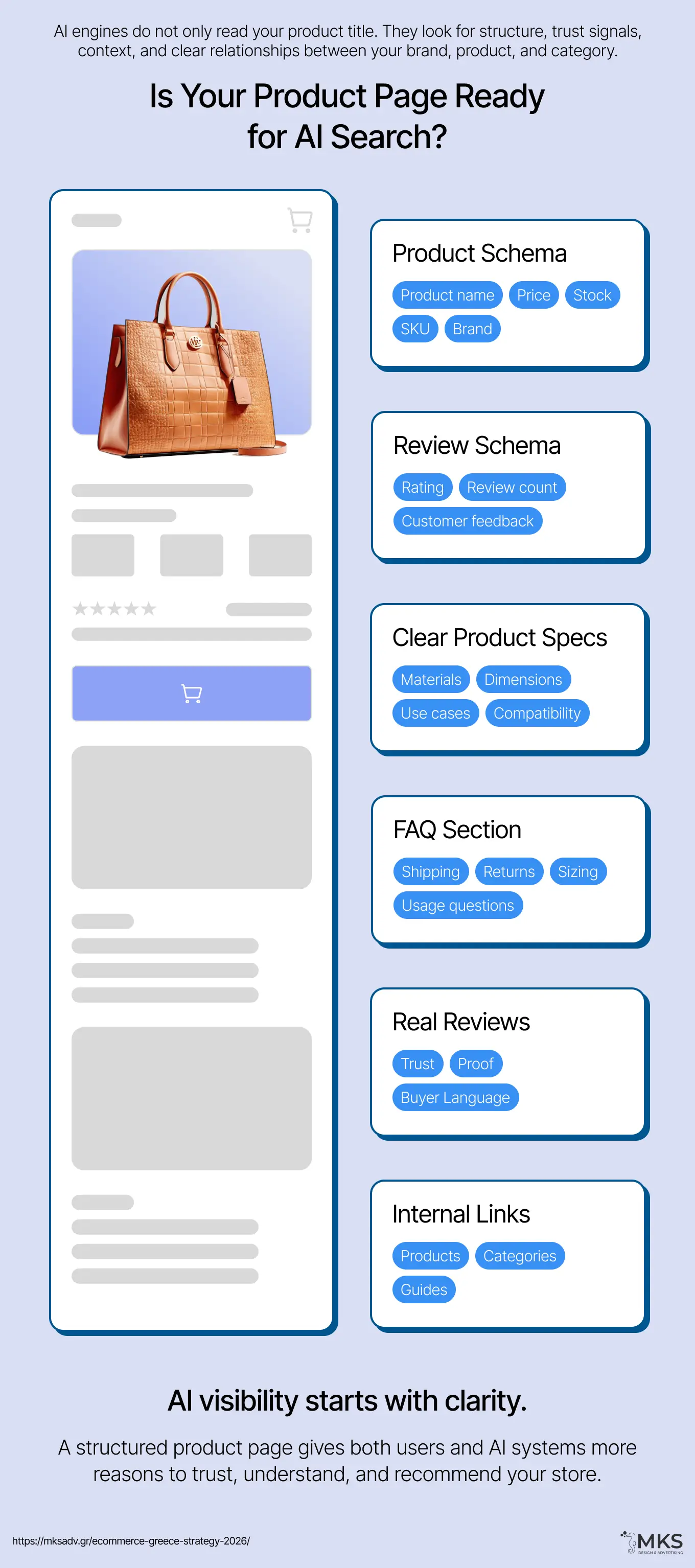
A growing share of product discovery is happening through AI engines: ChatGPT, Gemini, Google AI Overviews, and Perplexity. The consumer who types a specific product query into one of these tools and receives a curated recommendation has not visited a comparison site. The brands in that answer are the only ones that exist in that moment.
For Greek eCommerce, AI search visibility is currently an early-mover advantage. Most stores have not structured their product pages and category content to perform well in these environments. The technical requirements — structured data markup, review schema, FAQ content, clear entity signals — are achievable for any store willing to invest in them systematically.
Brand versus the promotion trap
Constant discounting is a strategy with a known outcome: customers who wait for the next sale. Greek eCommerce brands that have built their revenue on promotional cycles have trained a customer base that has no reason to pay full price. Undoing this pattern takes time and short-term revenue sacrifice.
The stores that will be in a strong position in three years are building brand preference today: a clear positioning, a consistent identity across channels, and a customer experience that people remember and recommend. None of this is incompatible with running promotions — it just means promotions are a tool rather than a strategy.
The sectors where Greek eCommerce has the most room to grow
Not every category in Greek eCommerce is equally contested. Four areas stand out in 2026 as having genuine room for well-positioned players to build a durable position.
Health, wellness, and supplements continue to grow faster than the overall market. Greek consumer interest in nutrition, fitness, and preventive health has expanded significantly, and the category still has gaps at the premium and specialist end that local brands with genuine expertise can occupy.
Outdoor, sport, and adventure equipment has benefited from a sustained shift in how Greeks spend leisure time. The coastal and mountain activity market in Greece is underserved by local eCommerce relative to the volume of activity it represents. International shipping costs and delivery uncertainty give local stores a structural advantage here.
Home and living at the mid-to-premium tier is a growing opportunity as Greek consumers continue to invest in their homes. The segment is competitive at the mass-market end but has significant white space above it.
Pet products represent one of the fastest-growing categories in Greek eCommerce by volume, and the market is still fragmented enough that a store with a clear niche — breed-specific nutrition, premium accessories, local sourcing — can build a loyal audience without competing directly on price.
Here at MKS Advertising, we have been working with Greek businesses on digital strategy for over 40 years. If you are building or repositioning an eCommerce operation and want a clear-eyed view of where to invest, we are happy to talk.