


AI search for business has changed the rules of online visibility, and most business owners have not been told what actually shifted.
If you have been running a business for any length of time, you have probably noticed that the way people search online has changed. Not in a subtle way. The results page you see today looks very different from what it looked like three years ago. Instead of ten links and a sponsored ad at the top, you increasingly get a composed answer, a summary, a recommendation. The search engine is not pointing you somewhere anymore. It is trying to answer you directly.
This shift has a name. People call it AI search, generative search, or answer engine optimization, depending on who is talking. And there is a lot of noise around it, most of it either too technical to act on or too vague to be useful. This article is neither. We are going to explain what is actually changing, what it means for your visibility as a business, and what a real strategy looks like in response.
The Old Search vs. The New Search
For most of the internet’s history, search worked like a directory. You typed a query, you got a list of websites, and you clicked through to find what you needed. The game for businesses was simple in theory: rank high enough on that list and you get traffic. That logic shaped an entire industry around keywords, backlinks, and technical optimisation.
What is happening now is structurally different. When someone asks Google a question today, they often receive an AI-generated answer at the top of the page before they ever see a single link. Platforms like
Platforms like Perplexity have built their entire model around this concept: answer the question, then cite the sources underneath. ChatGPT, Gemini, and others are moving in the same direction.
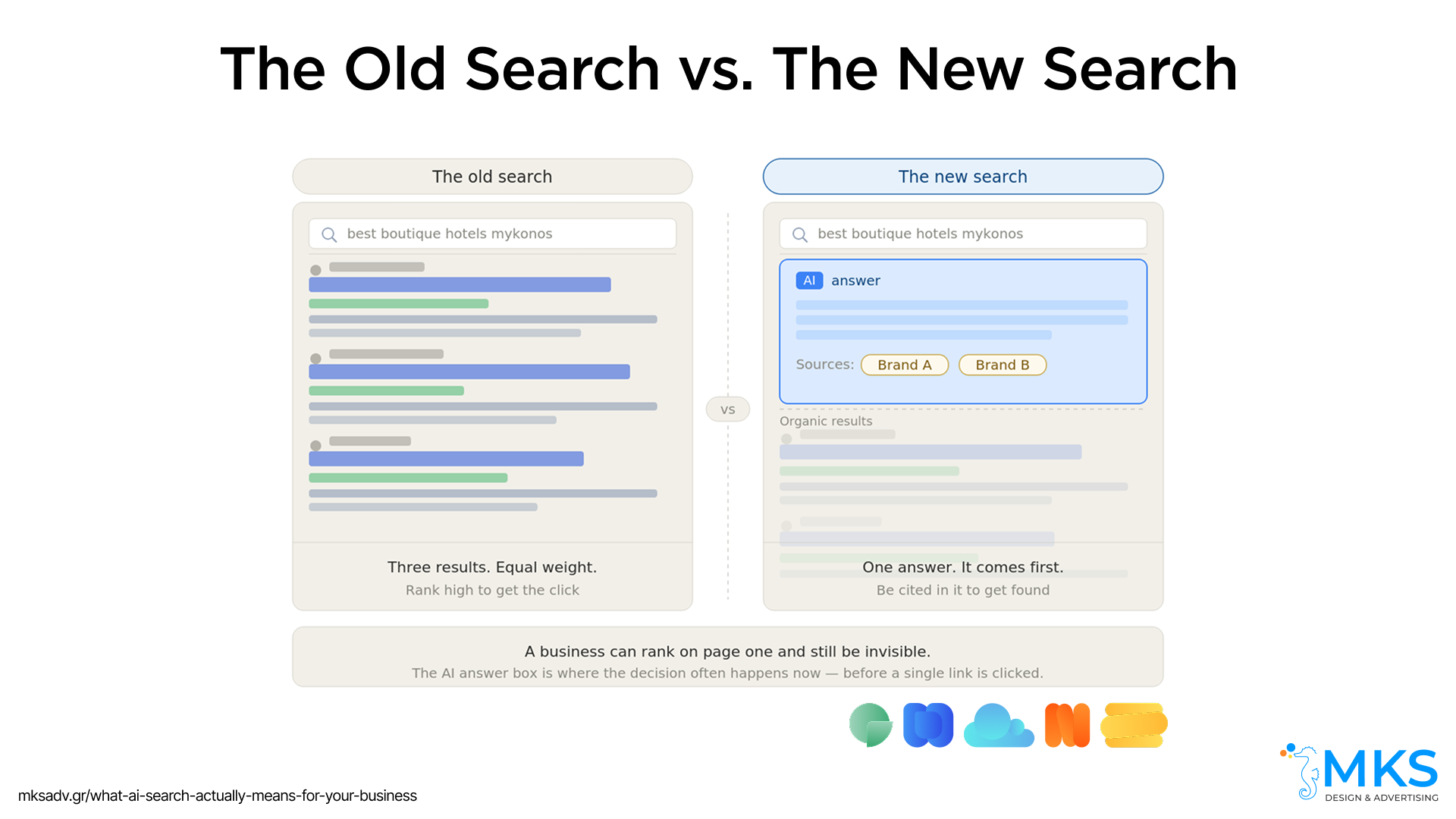
The result is that a business can rank on page one of Google and still be invisible. If the AI answer covers the topic and your brand is not cited in it, you have been filtered out before the reader even starts scrolling.
A business can rank on page one of Google and still be invisible in AI search. That gap is where strategies are either winning or losing right now.
Why Being on Google Is No Longer Enough
This is the part that matters most for businesses with a serious marketing budget, because it changes what you should be paying for and what you should be measuring.
Traditional SEO optimised for click-through. The goal was to get someone to visit your website. AI search optimises for inclusion. The goal now is to be the source that the AI cites when it composes an answer. These are different objectives, and they require different approaches.
Being well-ranked for a keyword does not automatically mean you will be included in an AI-generated answer. AI engines pull from sources they consider trustworthy, well-structured, and genuinely relevant to the question being asked. They look for depth, consistency, and credibility across multiple signals. A fast website with good metadata is table stakes. What the AI is really evaluating is whether your content answers questions the way a knowledgeable, reliable source would.
What AI Engines Actually Look For
This is where a lot of the advice you will find online goes wrong. People treat AI search optimisation as a technical checklist: add schema markup, use structured data, write FAQ sections. Those things can help at the margins. But they miss the more important point.
AI engines are trained to recognise genuine authority. They look for content that covers topics thoroughly, that is consistent over time, and that is referenced or echoed across the web by other sources. In practice, that means:
- Answering real questions with real depth, not surface-level summaries
- Maintaining a consistent presence and point of view on the topics relevant to your business
- Building the kind of reputation that earns mentions, citations, and references from others in your industry
- Structuring your content so that the answer to a specific question is easy to extract and verify
Notice that none of those are new ideas. They are the same things that have always separated strong content from weak content. The difference is that AI search rewards them more directly and more immediately than traditional search did.
Research from Search Engine Land and other industry sources consistently shows that AI-generated answers favour content that demonstrates expertise, real-world experience, and topical depth. Thin content and keyword-stuffed pages are being filtered out faster than ever.
AI engines are not fooled by the same shortcuts that gamed traditional search. They are looking for genuine authority, and they are getting better at telling the difference.
The Mistake Most Businesses Are Making Right Now
There are two failure modes we see regularly. The first is ignoring AI search entirely, treating it as a passing trend or something to worry about later. The second is chasing it with the wrong tactics: producing large volumes of AI-generated content to game the system, buying quick-fix AI SEO packages, or making one-off technical adjustments and hoping for the best.
Neither approach works. Businesses that ignore AI search are quietly losing visibility to competitors who are paying attention. Businesses that try to shortcut it are producing content that AI engines are specifically designed to deprioritise.
The uncomfortable truth is that there is no shortcut here. AI search rewards the same things that good marketing has always rewarded: a clear message, consistent effort, and content that actually earns the trust of the people reading it.
What a Serious AI Search Strategy for Business Actually Looks Like
This is where experience matters. We have watched enough shifts in how audiences find and choose brands to know that the fundamental response is always the same, even when the technology changes.
A serious AI search strategy starts with the questions your clients are actually asking. Not keyword lists, not what ranks well for your competitors. The real questions your real clients type into a search bar at 11pm when they are trying to figure something out. Build content that answers those questions properly, with the depth and clarity that a genuinely knowledgeable person would bring to them.
Then maintain it. One well-written article is a start. A consistent body of content that covers your area of expertise from multiple angles, updated over time, is what builds the kind of authority that AI engines recognise and cite.
Finally, make sure the structural layer is in order. Page speed, clean markup, clear topic organisation. Not because these things alone will win you AI visibility, but because they remove the friction that prevents good content from being properly indexed and understood.
If you want a broader picture of how this fits into a full digital strategy, our piece on what a 360 agency actually does covers the relationship between channel strategy and content.
Where to Start If You Are Behind
If AI search has not been part of your strategy yet, the starting point is simpler than you might expect.
- Audit what you already have. Which existing pages answer real questions well? These are your foundation.
- Identify the five to ten questions your clients ask most often before they decide to work with someone like you. Build dedicated, thorough content around each one.
- Review your content structure. Are your answers easy to extract? Are your pages clearly organised around specific topics?
- Look at who is already appearing in AI answers for your key topics. What are they doing that you are not?
You can also read our take on Anti-AI Marketing for a different angle on how businesses are navigating the AI moment in ways that do not rely on chasing every new tool.
The Filter Has Changed. The Fundamentals Have Not.
AI search is not a threat if you have been doing real marketing. It is a filter. It separates brands that have been building genuine authority from those that have been gaming shortcuts.
After 40 years in the Greek market and across multiple seismic shifts in how advertising works, the pattern is always the same. Every new channel, every new algorithm, every new technology rewards the brands that were already doing the right things. AI search is the latest example of that.
The businesses that will win in AI search are the ones with clear positioning, consistent content, and a genuine point of view. If that describes you, you are in a better position than you think. If it does not, now is the right time to build it.
If you want to understand where your brand stands in the new search landscape, that is a conversation worth having.
Get in touch at mksadv.gr or through the contact form on our site.