

Picture a setup that many growing businesses know well. You have an agency running your Google Ads. A freelancer handling your SEO. Someone else managing your social media. Each of them sends a monthly report. The numbers show activity. Things appear to be moving.
But if someone from your leadership team asked right now, “how is our digital marketing performing overall?” how long would it take to give a confident, complete answer? For most businesses in this situation, the honest answer is: longer than it should.
This is not the result of bad decisions. Most businesses arrive at a fragmented digital setup through perfectly rational steps. They hired an SEO specialist when SEO became important. They brought in a paid media team for a campaign that needed to launch quickly. They added a social media manager when their audience expected a presence there. Each choice made sense on its own.
The problem is not any individual vendor. The problem is that nobody owns the whole picture. And when nobody owns the whole picture, strategy gets replaced by administration. This article explains what a genuinely integrated 360 approach looks like, how it differs from simply having multiple services under one roof, and what the difference produces for your revenue.
The Fragmented Setup Most Businesses Are Stuck In
The fragmented digital setup is almost universal among businesses that have been growing for a few years. It develops naturally. A recommendation here, a good experience there, a specialist hired for a specific need. Before long, you have three or four vendors each doing their part, and no single person who can give you a clear, integrated view of what your digital marketing is actually producing.
The symptoms are recognisable once you know what to look for.
The warning signs
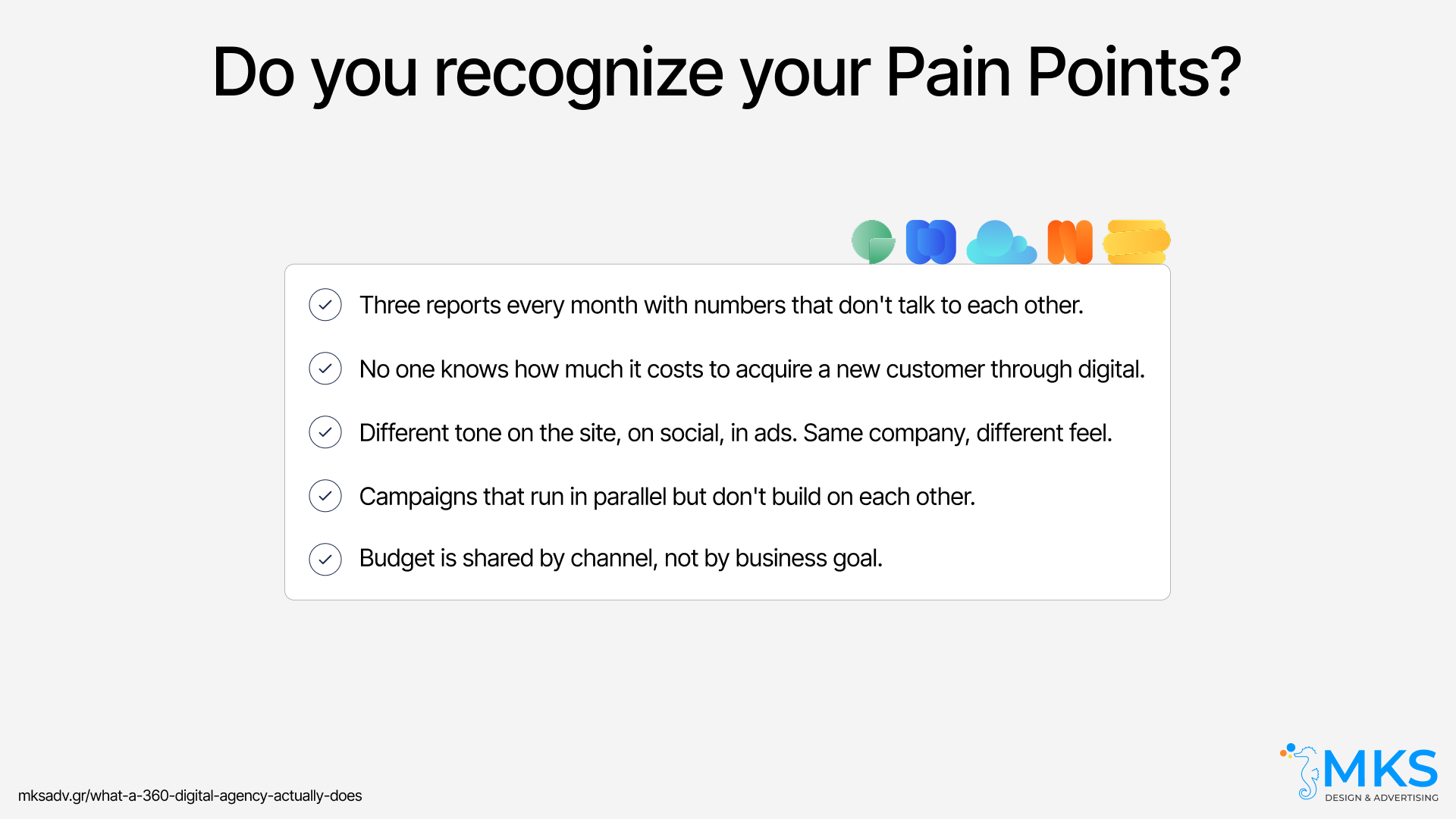
- You receive monthly reports from multiple sources that use different metrics, different time frames, and different definitions of success. Reconciling them takes time and still leaves gaps.
- Nobody can tell you with confidence what your true cost of acquiring a new customer is across all digital channels combined.
- Your brand voice shifts between channels. The tone on your website, in your ads, and across your social media feels like it was written by different people, because it was.
- Campaigns run in parallel but do not build on each other. A content piece produced for the blog has no connection to what paid is running that month. A paid campaign launches without the SEO team being aware of it.
- Your budget is allocated by channel rather than by business objective. The conversation is about how much to spend on Google Ads versus SEO, rather than what revenue target you are working toward and which channel mix gets you there most efficientl
If two or three of these sound familiar, the setup is not failing. It has simply reached the ceiling of what a collection of independent workstreams can deliver. The next level of performance requires something structurally different.
What 360 Actually Means (And What It Does Not)
The term gets used loosely enough that it has lost some meaning. A 360 agency is not simply an agency that offers a long list of services. Many agencies do that without any genuine integration between them. Each team works in its own world, optimises for its own metrics, and hands over a report at the end of the month. That is a full-service agency. It is not a 360 agency.
A genuine 360 approach is architectural. It means that every channel is built around a single unified strategy, shares data with every other channel, and is accountable to business outcomes rather than channel-level metrics. The difference is not in the service list. It is in how those services relate to each other and to your actual business goals.
One strategy, many channels
The campaign idea, the brand message, and the business objective are set once. From there, each channel is given a specific role that suits what it does best. SEO builds long-term visibility for the searches that matter to your business. Paid media captures demand that already exists and delivers immediate, measurable results. Social media builds the relationship with your audience over time. Content connects all of it and feeds each of the others.
Every channel expresses the same strategy differently. The person who finds you through an organic search should encounter the same brand as the person who sees your retargeting ad or reads your LinkedIn post. Consistency across touchpoints is not a design preference. It is a revenue driver.
The goal is not to be everywhere. It is to be coherent everywhere. A buyer who finds you through search, then sees your ad, then reads your blog should feel like they are meeting the same company each time
Shared data, sharper decisions
When all channels run under one roof with shared access to the same data, something changes in how decisions get made. A keyword that is converting well in paid search becomes an organic content priority. A piece of content that is generating unusually high engagement gets amplified through paid. An audience segment that emerges from social data gets targeted with a specific message in display.
None of this happens naturally when channels are managed by separate vendors with no shared view of the numbers. It requires one team that sees everything, connects the signals, and acts on the full picture rather than a fragment of it.
One point of accountability
This is the change that most clients feel most immediately. Instead of three sets of monthly reports, three separate relationships to manage, and the persistent sense that nobody is responsible for the overall result, there is one conversation. One team that knows your business, understands your targets, and is accountable for the whole picture.
That accountability changes the nature of the relationship. It is no longer a vendor relationship where each party is defending their slice of the work. It becomes a partnership where the agency’s success is directly tied to yours.
What This Changes for Your Revenue
Structure matters, but what business owners and CFOs care about in the end is what it produces. Here are three concrete ways integrated strategy changes the numbers.
Lower cost of customer acquisition
When paid and organic channels work together, you stop paying to acquire visitors who could have found you for free. A user who has already read three pieces of your content costs less to convert through paid retargeting than a cold audience member who has never encountered your brand. The SEO authority you build through consistent content raises your Quality Score in Google Ads, which directly reduces your cost per click.
These are not theoretical relationships. They produce measurable differences in acquisition cost over a 12 to 18 month horizon, and they compound. The stronger your organic presence, the more efficient your paid spend becomes. The more precise your paid targeting, the more your content reaches audiences that are already primed to convert.
Faster compounding growth
In a fragmented setup, each channel grows until it plateaus on its own. The SEO results level off. The paid performance stabilises. Social engagement sits at a steady baseline. Each channel is doing its job, but none of them is building on what the others are doing.
In an integrated model, each channel lifts the others. Brand recognition built through social consistency reduces paid acquisition cost. Topical authority built through content improves organic rankings and reduces dependence on paid. Paid data informs which organic content priorities will have the highest commercial impact. The result is not additive. It compounds. And compounding growth is what separates businesses that scale from those that plateau at a respectable but static revenue level.
Clearer decision-making
When one team can tell you exactly what is working, why it is working, and what it is producing in revenue terms, you stop making budget decisions based on habit or inertia. You stop renewing contracts because changing feels risky. You stop splitting budget based on what each vendor is asking for rather than what the business actually needs.
You make decisions. Informed ones. With a clear view of the next quarter rather than a vague sense that things are going reasonably well.
What Working With a 360 Agency Actually Looks Like
It helps to make this concrete. The first 90 days of a properly integrated engagement follow a specific pattern that is worth understanding before you commit to anything.
Audit before action
Before any campaign launches, any strategy is written, or any existing work is changed, there is a thorough audit of where the business currently stands across all channels. What is working and why. What is not working and what it is costing. Where the gaps are between what the brand says it is and what the channels are actually communicating. Where budget is being spent without a clear line to business outcomes.
This is not a formality. It is the foundation on which every decision that follows is built. An integrated strategy built without this foundation is not a strategy. It is a collection of assumptions dressed up as a plan.
Strategy before tactics
Revenue targets, audience priorities, and competitive positioning are established first. Then, and only then, do the channels get assigned roles. The question is never “should we run Google Ads?” The question is “what do we need to achieve, and which combination of channels gets us there at the lowest cost with the highest probability of success?”
This sequence sounds obvious when stated plainly. But in practice, most fragmented setups do it the other way around. The channels exist, so the strategy is built around them rather than the other way.
Unified reporting from day one
From the first full month of engagement, there is one report. One view that shows performance across all channels in terms of business outcomes rather than channel metrics. Not “organic traffic is up 12%” but “organic search generated 47 qualified leads this month at an average cost of acquisition of X.” Not “our CPM improved” but “paid media contributed Y euros in pipeline revenue this quarter.”
This language, the language of business outcomes rather than activity metrics, is what makes the monthly conversation with your agency useful rather than just informative.
The MKS Approach
The 360 model MKS operates on did not start with digital. It started with four decades of understanding what makes communication work in the Greek market, and a conviction that the arrival of digital channels was an expansion of that challenge, not a replacement of it.
Traditional advertising taught how to build a brand, how to tell a story that stays with people, and how to create a long-term relationship between a company and the audience it depends on. Digital marketing brought precision, measurability, and the ability to reach a specific person with a specific message at a specific moment. The 360 approach is what happens when neither discipline is sacrificed for the other.
There is no advertising and digital. There is communication. The channels change. The need for consistent, honest communication does not.
Every integrated strategy MKS builds carries both of those things. The strategic depth that comes from understanding how markets evolve, and the technical precision that comes from operating at the front edge of what digital channels can do. That combination is what produces results that hold up over time, not just in the first quarter after launch.
One Question Worth Asking Yourself
If someone from your leadership team asked you right now what your digital marketing produced last month in terms of new customers and what each one cost, how quickly could you give a complete, confident answer?
If the answer is immediately, your current setup is working at the level it needs to. If the answer involves gathering data from several places and making some assumptions along the way, that gap is worth a conversation.
You do not need to change everything to start. You just need a clear view of where you stand.
Get in touch at mksadv.gr or through the contact form on our site.