

You spent real money on that website. A designer built it. The photos look great. Your family said it was impressive. And yet, when the bookings come in, most of them are still through Booking.com or Expedia and each one is costing you somewhere between 15 and 22% in commission.
You are not alone in this. Getting direct bookings consistently is one of the biggest challenges we hear from Greek hotel and villa owners. The website exists. It looks the part. But it is not actually working for you.
The website exists. It looks the part. But it is not actually working for you.
So let us walk through what is actually going on. No complicated terminology, just a straightforward explanation of why the two things, looking good and getting found, are not the same.
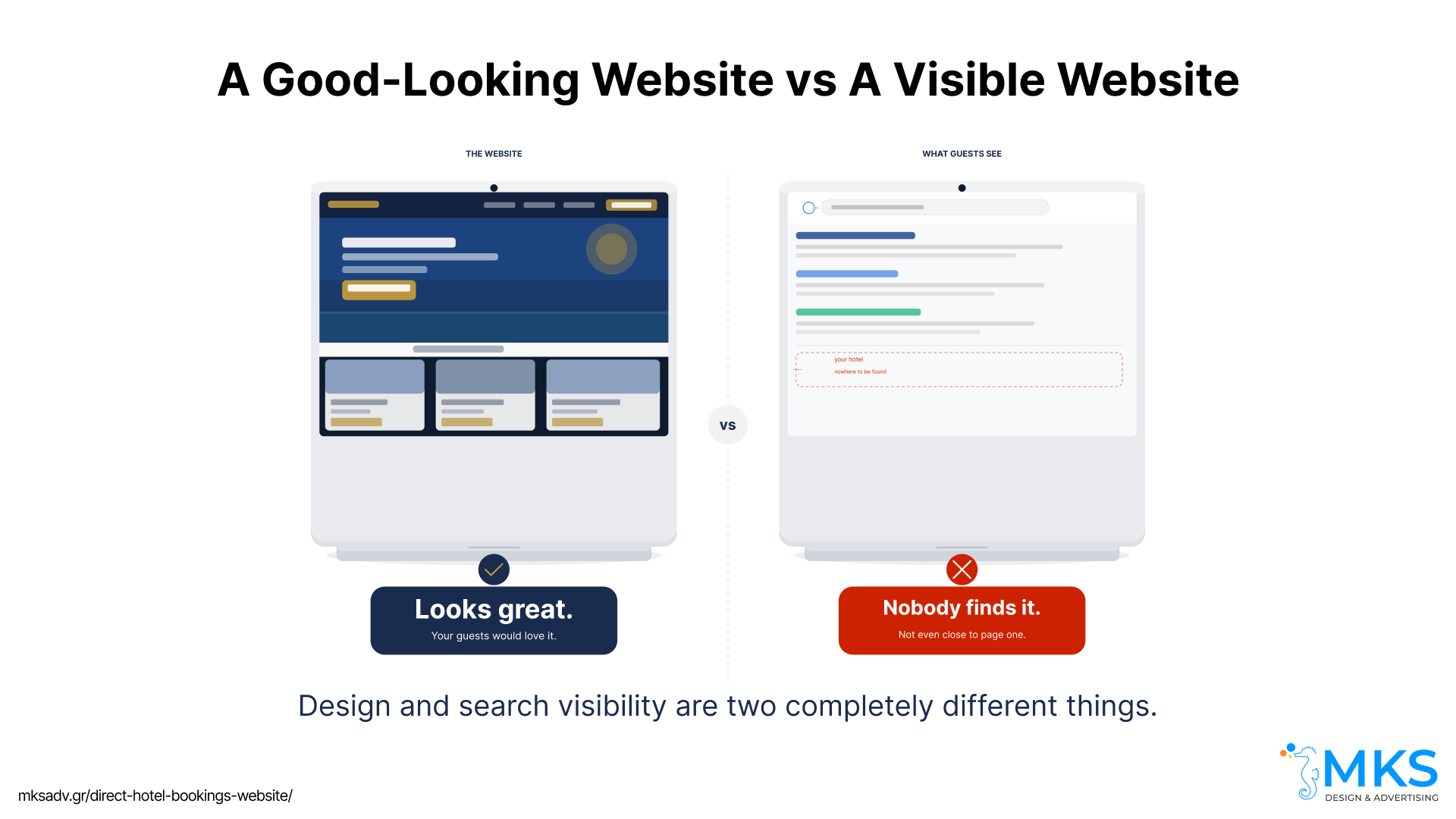
A good-looking website and a visible website are two very different things
This is the part most people miss. When you built your website, the goal was to make a good impression. And it probably does. If someone already knows your hotel exists and types your name directly into Google, they will find a polished, professional page.
But that is not how most guests find a place to stay.
Most travellers start with a search. They type something like “boutique hotel Crete with pool” or “family hotel Heraklion near beach” and they look at whatever Google shows them first. If your website is not in those results, it does not matter how beautiful it is. Nobody lands on a page they never knew existed.
Think of it this way: imagine opening a beautiful restaurant in a street that nobody walks down. The food is excellent, the interior is stunning, but the street has no foot traffic and no signs pointing to it. That is what many hotel websites look like online.
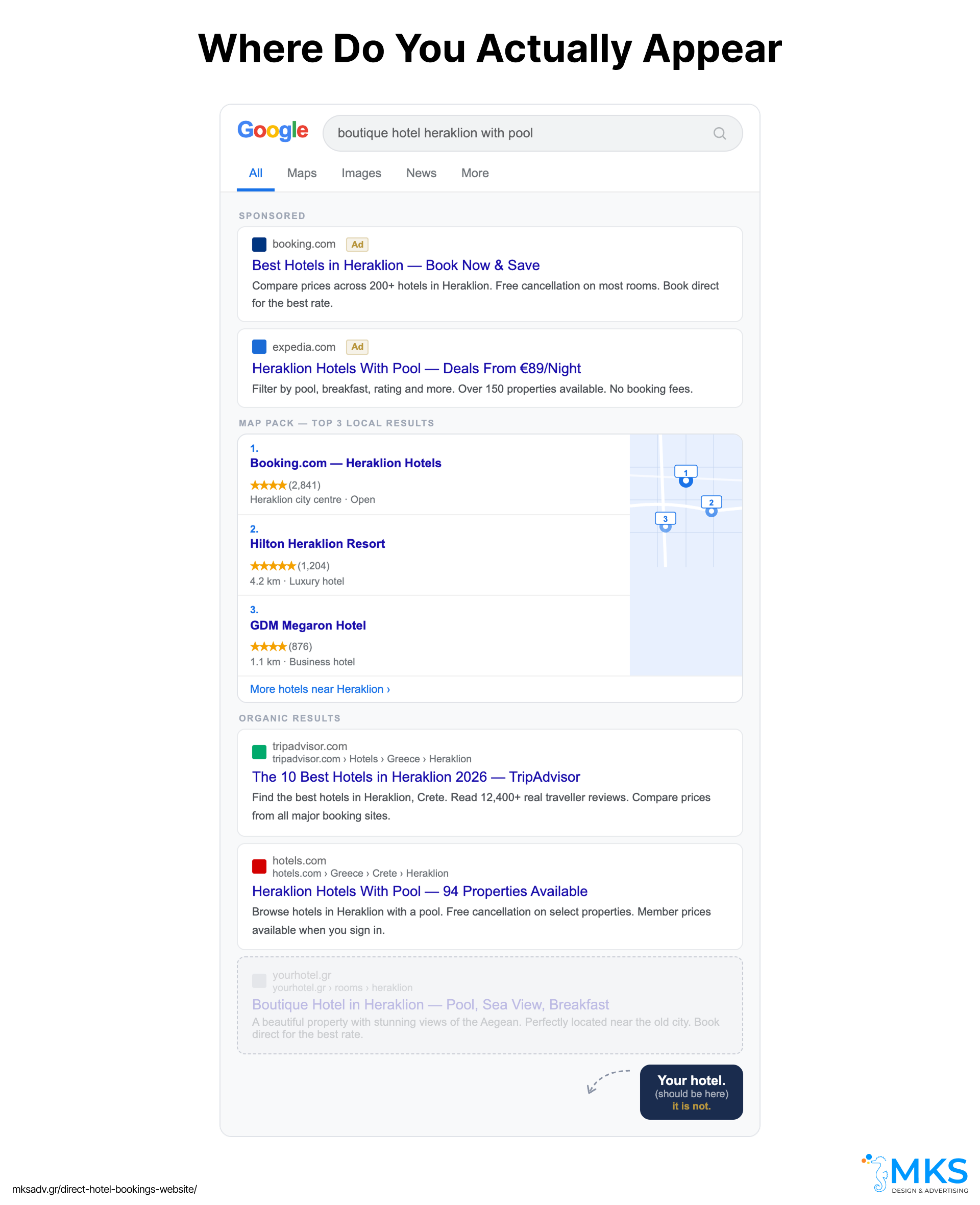
When a guest searches for a hotel like yours, where do you actually appear?
Let us walk through what actually happens when someone searches for accommodation in your area.
Google shows several layers of results. At the very top, there are paid ads. Below that, there is usually a map with three hotel listings, this is called the local pack. Then there are the organic results, which is the list of websites Google considers most relevant and trustworthy for that search.
Most hotel websites in Greece, especially independent properties, appear nowhere on that first page for the searches that matter. The spaces are taken up by Booking.com, TripAdvisor, Expedia, and the larger chain hotels that have been investing in their digital presence for years.
The guest never reaches your website. They book through the platform. You get the reservation, minus the commission.
Three reasons most hotel websites stay invisible
There is no single reason this happens. It is usually a combination of a few things that compound over time. Here are the three most common ones.
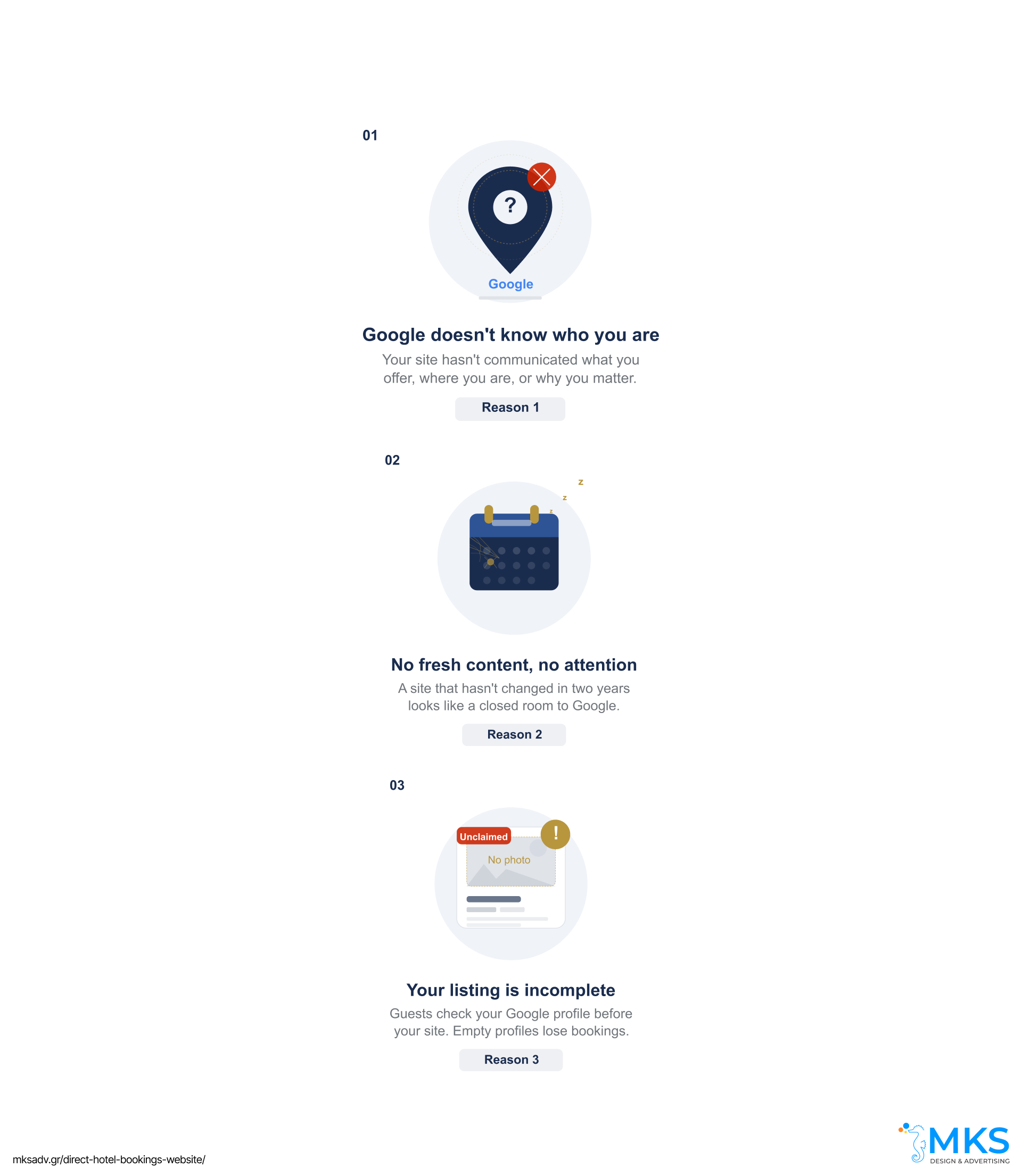
1. Google Does Not Know Enough About You
Google is trying to match a traveler’s search with the most relevant result. To do that well, it needs to understand who you are, what kind of property you run, where you are, what makes you different, and who your guests are.
If your website has not been set up to communicate those things clearly, Google cannot rank it confidently. It is not that Google dislikes your site. It simply does not have enough information to send people there. This is fixable, but it requires specific work that most website builders do not include by default.
2. Your Website Has No Fresh Reason for Google to Pay Attention
Google pays more attention to websites that are active. A website that was launched two years ago, with the same content and no updates since, looks like a closed room to a search engine. It is still there, but nothing is happening.
Regular content, whether that is a short blog, updated pages, or seasonal information, tells Google that your business is alive and relevant. You do not need to publish every day. But total silence over months is something Google notices.
3. You Are Not Listed Properly Where the Decision Is Actually Made
Many travellers make their accommodation decision before they even visit your website. They search, they see your name in Google Maps or on a review platform, they check your photos and reviews, and they decide from there.
If your Google Business Profile is incomplete, if your photos are outdated, if your address details are inconsistent across platforms, or if you have not responded to reviews in months, that is the impression guests are forming about your property. And many hotels have not even claimed their official Google Business listing yet.
What Losing Direct Bookings Actually Costs You
Let us put some numbers to this, because the cost of invisibility is real and it adds up quietly.
Say your hotel does 150 bookings through OTAs in a season. The average stay is three nights at 120 euros per night. That is 54,000 euros in OTA revenue. At a 20% commission rate, you are paying 10,800 euros to Booking.com for guests who, with the right digital presence, could have found you directly.
That money is not a cost you are avoiding by skipping marketing. It is revenue you are already earning, and a slice of it walks out the door every single season because a guest who could have booked you directly ended up on Booking.com first.
The goal is not to abandon OTAs entirely. They have their place, especially for filling gaps and reaching new markets. The goal is to reduce your dependency on them, one direct booking at a time.
What Changes When Direct Bookings Start Coming In
Getting your digital presence in order is not a dramatic overnight transformation. But the shift, when it happens, is steady and compounding.
More guests find you through Google before they reach Booking.com. Some of them book directly through your own website. You start to build a guest relationship from the first contact rather than from check-in. Your reviews accumulate in one consistent place. Your name starts appearing in searches you were invisible in before.
Independent hotels with a well-managed digital presence also tend to attract a slightly different type of guest: one who chose your property specifically, not just the nearest available option in their price range. That guest is usually more engaged, more likely to return, and more likely to recommend you.
Where to Start, Without Getting Overwhelmed
You do not need to fix everything at once. Here are three things you can do this week that will give you a clearer picture of where you stand.
- Open Google and search for what your guests would search. Try something like ’boutique hotel [your area]’ or ‘hotel near [local landmark]’. See where you appear, or do not appear. That is your baseline.
- Find your Google Business Profile. Search your hotel name on Google Maps. If the listing is incomplete, if the photos are old, or if you have never logged into it, that is a meaningful gap to close,and it is free to fix.
- Talk to a digital partner who understands hospitality. Not a generalist who handles everything from e-shops to dentist websites. Someone who has worked with hotels and understands the specific dynamics of how guests search, compare, and book.
Building a steady stream of direct bookings does not happen overnight, but it starts with the same thing every time: making sure guests can actually find you before they find Booking.com.
At MKS Advertising, we work with hospitality businesses across Greece on exactly this kind of digital presence work. If you are not sure where your property stands online, we would be happy to take a look with you.